
The interest rate tells you what you pay to borrow the principal; APR adds in certain upfront fees to show a fuller yearly cost, which is why APR usually sits at or above the interest rate. Run the loan its full term and APR is the fairer comparison tool. Sell, refinance, or pay it off early, and the interest rate plus your actual fees matter more. Credit cards are the exception: the two numbers are typically identical.
TL;DR:
- The APR includes upfront fees like origination and mortgage insurance, often making it significantly higher than the interest rate, especially on personal loans.
- For loans expected to last their full term, APR offers a better comparison; for early repayment, the interest rate plus actual fees give a more accurate cost.
- The gap between APR and interest rate widens with larger upfront fees and shorter expected holding periods, making detailed calculations essential.
- Credit cards typically have identical APR and interest rates because they rarely include upfront fees, unlike mortgages and personal loans with varied fee structures.
- Always request a detailed breakdown of fees included in the APR and use your own expected holding period to evaluate the true cost of a loan.
Table of Contents
- APR vs interest rate: what the interest rate actually controls
- What APR is and which fees it can include
- A worked example: how one fee changes APR vs interest rate
- When to prioritize APR and when the interest rate matters more
- APR, APY, and why holding period breaks the comparison
- APR vs interest rate across auto loans, personal loans, and beyond
- How your credit score changes both numbers
- Using APR and interest rate together to compare loan offers
- Checklist: what I tell borrowers to check before signing anything
- Test your own numbers before you commit to a lender
- Sources
- FAQ
APR vs interest rate: what the interest rate actually controls
The interest rate is the annual percentage a lender charges on the money you borrow, before any fees enter the picture. It is the number that drives your monthly payment calculation, full stop. If you're staring at a mortgage quote and want to know what you'll pay each month, the interest rate, the loan amount, and the amortization period are the only three inputs that matter.
Rates come in two flavours:
- Fixed rate — locked for the term, so your payment never moves regardless of what the Bank of Canada does.
- Variable rate — tied to prime, so payments (or, in some structures, the amortization) shift as the benchmark shifts.
Here's the quick math that shows why this number matters so much on its own: a mortgage loan with a slightly higher interest rate results in a noticeably higher monthly payment, illustrating how the interest rate alone drives monthly costs. No fee, no APR calculation, touches your payment amount. The interest rate is the engine; everything else is packaging.
What APR is and which fees it can include
APR is the annualized measure of borrowing cost that folds the interest rate together with many of the upfront fees a lender charges, which is why it's usually equal to or higher than the stated rate. Think of it as the lender's attempt to answer a more complete question: not just "what's your rate," but "what does this loan actually cost you over a year, once you account for what it took to get it."
Fees that commonly get baked into a mortgage APR include:
- Origination fees or lender administration charges
- Discount points paid to buy down the rate
- Mortgage default insurance premiums, where applicable
- Certain closing costs the lender itself charges
The catch is that lenders don't all draw this line in the same place. One lender's APR might absorb an appraisal fee; another's might exclude it. That inconsistency is exactly why you should ask each lender for a plain-language breakdown of what's rolled into their APR before comparing two offers side by side, a step that aligns with the Cost of Borrowing disclosure principles that push lenders toward clearer, more comparable cost information.
Credit cards break this pattern entirely. Because most cards charge no origination fee, the purchase APR and the interest rate are usually the same number. If your card statement lists 21.99% APR, that's also your interest rate on carried balances.
Pro Tip: Before signing anything, ask the lender one direct question: "Which fees are included in this APR figure?" A vague answer is itself useful information about how that lender operates.
A worked example: how one fee changes APR vs interest rate
Numbers make this concrete faster than any definition. Take a straightforward personal loan and watch what one fee does to the two figures.
- The loan: $10,000 borrowed at a stated 6% interest rate over a three-year term, with a $500 origination fee charged upfront.
- The payment: your monthly payment is calculated purely off the 6% rate and the $10,000 principal, landing at roughly $304 a month. The fee never enters this calculation.
- The APR: when that $500 fee gets spread across the loan's cost over three years, the annualized figure comes out higher than 6%, often in the 8% range depending on exactly how the lender amortizes the fee.
That gap, roughly two percentage points in this example, is the fee's cost expressed as a yearly rate. Here's the practical wrinkle: if you keep this loan for all three years, the APR gives you a fair, single number for comparing it against a fee-free loan at a slightly higher rate. But if you plan to pay it off in month eight, that $500 fee still cost you $500. It doesn't shrink because you left early. The APR spreads that cost thin over the full term on paper; in your wallet, it landed all at once.
When to prioritize APR and when the interest rate matters more
The decision rule comes down to one question: how long will you actually hold this loan?
- Planning to keep it to term? APR is your best apples-to-apples number, since it assumes the loan runs its full length and spreads any upfront fees across that entire period.
- Planning to sell, refinance, or pay it off early? Skip the APR and instead add the interest rate's real cost over your expected holding period to the actual dollar fees. A Mortgage Refinance Calculator does this math for you far faster than a spreadsheet.
- Comparing credit cards? APR and interest rate are usually identical, so your real battleground is grace periods, minimum payment traps, and whether you're carrying a balance at all.
- Watching a variable rate or an introductory offer? Both APR and interest rate are snapshots. A rate that resets after twelve months, or a variable rate tied to prime, can make either figure stale within a year.
Pro Tip: Before comparing two mortgage offers, check whether either one carries a prepayment penalty. A Mortgage Penalty Calculator can show you whether an early exit erases the savings a lower APR promised.
APR, APY, and why holding period breaks the comparison
APR and APY are not interchangeable, and mixing them up is one of the more common comparison mistakes. APY, or annual percentage yield, is the savings-account cousin of APR. It accounts for compounding, meaning interest earned on interest, which is exactly what APR does not do. APR is a simple annualized figure; it doesn't factor in how often interest compounds on the loan itself, even though compounding frequency can meaningfully change what you actually owe over time.
The bigger issue for borrowers is that APR assumes you keep the loan for its entire original term. That assumption quietly breaks down the moment you refinance a mortgage in year four of a 25 year amortization, or pay off a personal loan eighteen months early. The upfront fees baked into that APR got spread across a term you never completed, so the "annualized" cost you saw at signing understated what those fees actually cost you per year of actual use.
APR vs interest rate across auto loans, personal loans, and beyond
Mortgages get most of the attention in this conversation, but the same logic governs auto loans, personal loans, and lines of credit, just with different fee structures attached.
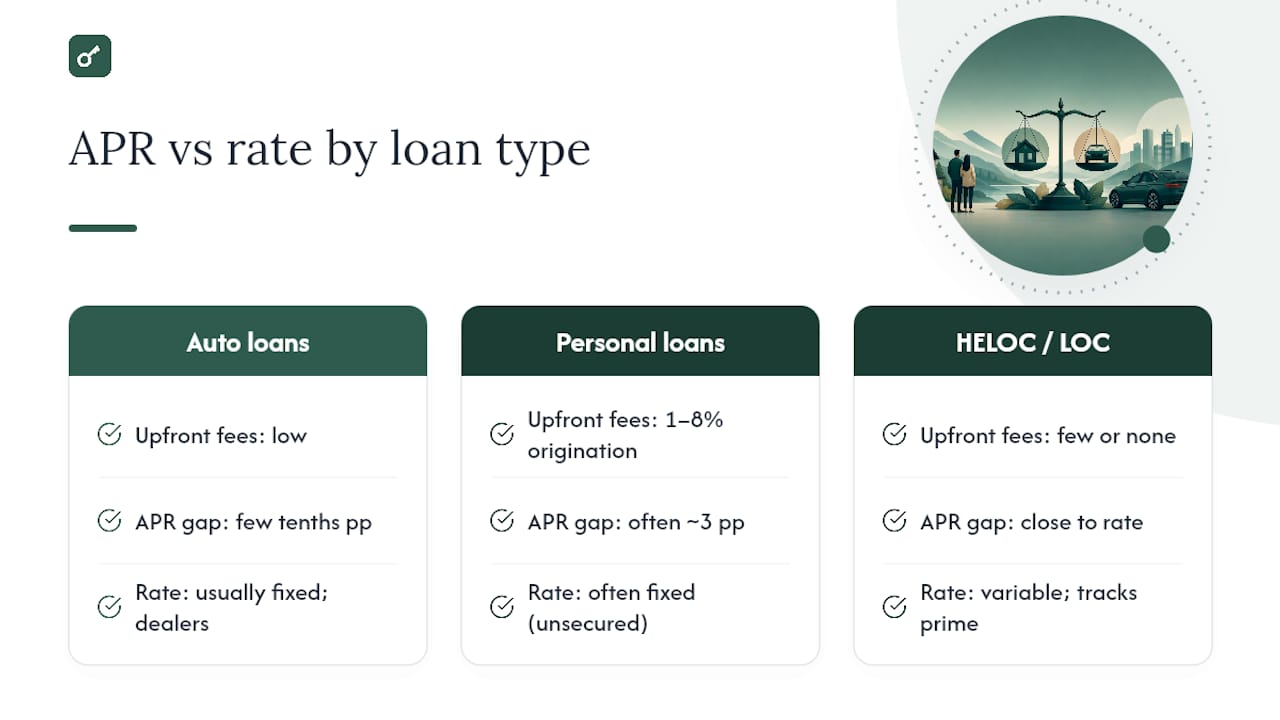
Auto loans rarely carry origination fees the way mortgages do, so the gap between APR and interest rate tends to be narrower, sometimes just a few tenths of a percentage point. Where the gap widens is dealer-arranged financing, which can bundle administration fees or documentation charges into the APR without always making that clear upfront. Always ask a dealer to isolate the interest rate from any add-on fees before you sign.
Personal loans, especially unsecured ones from online lenders, often carry the largest APR-to-rate gap of any common loan type. Origination fees on personal loans can run from 1% to 8% of the loan amount, which is precisely the mechanism in the earlier worked example. A personal loan advertised at an appealing 7% interest rate can carry an APR closer to 10% once a sizeable origination fee gets factored in.
Lines of credit and HELOCs typically quote a variable interest rate with few or no upfront fees, so APR and interest rate often sit close together, but the variable nature means both numbers move with prime. A HELOC Calculator is worth running before you assume today's rate holds steady.
The pattern across all of these: more upfront fees mean a wider APR gap, and shorter typical holding periods mean that gap matters less in practice.
How your credit score changes both numbers
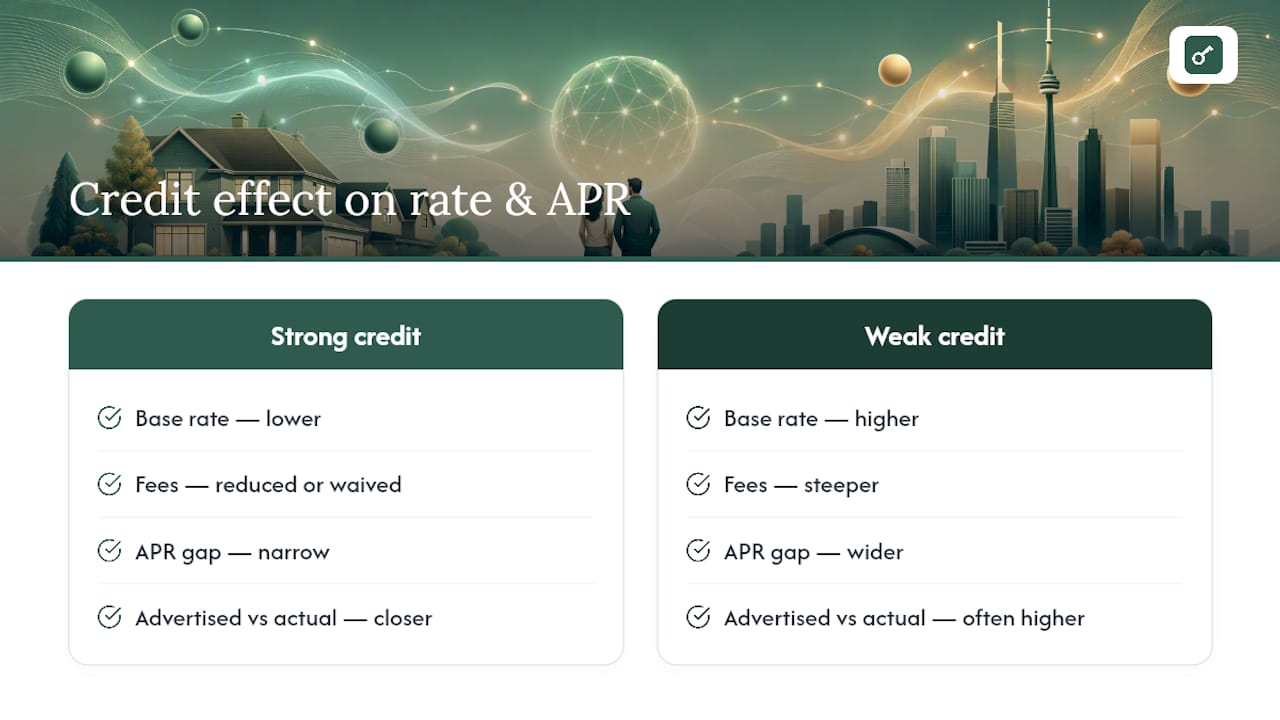
Your credit score doesn't just affect the interest rate a lender offers, it affects the APR too, and often by more than borrowers expect. Lenders reserve their best pricing, on both the base rate and the fee structure, for borrowers with stronger credit profiles. A borrower with excellent credit might get offered a loan with a lower rate and reduced or waived origination fees, which narrows the APR gap. A borrower with a thinner or weaker credit file often faces both a higher base rate and steeper fees, which widens the gap between what they see advertised and what they'll actually pay annually.
This compounding effect catches people off guard. Two borrowers can look at the same lender's website, see the same advertised "rates from" figure, and end up with meaningfully different APRs once underwriting factors in income stability, existing debt load, and credit history. That's also why the lowest advertised rate on any lender's homepage is rarely the rate a specific borrower will actually receive; it's the rate offered to the strongest applicants in that lender's pool.
Debt-to-income ratio, down payment size, and loan-to-value ratio on mortgages all feed into this same calculation. A larger down payment can reduce or eliminate mortgage default insurance premiums, which directly narrows the gap between your interest rate and your APR since one of the fee components simply disappears.
Using APR and interest rate together to compare loan offers
Neither number tells the full story alone, so the smartest move is using them as a pair, not picking a favourite.
Start by lining up the interest rate across every offer you're considering. That number tells you the baseline cost and lets you calculate a real monthly payment for each option using a tool like a Mortgage Payment Calculator. Then look at the APR on each offer and ask what's driving the gap between the two figures. A small gap usually means low fees. A large gap means someone is charging you meaningfully more to originate the loan, even if the headline rate looked attractive.
Next, be honest about your holding period. If you genuinely expect to keep a mortgage for its full amortization, weight APR heavily in your decision. If you know you'll likely move or refinance within a shorter timeframe, do the fee math for that shorter window instead of trusting the full-term APR figure. Add the dollar cost of fees to the interest cost over your realistic timeframe, then compare that total across offers.
Finally, always request the specific fee breakdown behind any advertised APR. Two lenders can advertise identical APRs while including entirely different fees in that number, which means the underlying interest rate, and your actual monthly payment, could differ even though the annualized figures match.
Checklist: what I tell borrowers to check before signing anything
Ask every lender for a full fee breakdown before you compare APRs. Run your actual expected holding period through a calculator rather than trusting the full-term APR by default, and check for prepayment penalties that could erase any savings from a lower rate.
The biggest mistake I see is treating APR as if it were a precise total dollar cost rather than an annualized estimate built on a full-term assumption. A close second: assuming a 0% APR promotion means zero cost, when annual fees or penalty charges can still apply underneath that headline number. Read what's excluded as carefully as what's included.
— Rachit
Test your own numbers before you commit to a lender
Reading about APR and interest rate only gets you so far. The gap between the two only becomes real once you plug in your own loan amount, your own rate quotes, and your own timeline. Costtoclose builds free calculators specifically so Canadian borrowers can do that math themselves instead of trusting a lender's summary sheet.
Start with the Mortgage Payment Calculator to see exactly what a quoted interest rate means for your monthly budget, then run the same numbers through the Mortgage Affordability Calculator to check the loan fits your income comfortably. If you're weighing whether a lower rate elsewhere is worth breaking your current term, the Mortgage Refinance Calculator models the trade-off using your actual expected holding period rather than a generic full-term assumption. All three tools pull real-time regional data, so the output reflects your market, not a national average. Open one, enter the numbers from your current quote, and see where the fees are actually hiding.
This article is general information, not a substitute for advice from a qualified financial advisor. Consult a qualified financial professional about your own circumstances before acting on anything here.
Sources
- Annual percentage rate (APR): Definition, Calculation, and Comparison | Investopedia
- Canada government (consumer disclosure / prescribed-interest reference)
FAQ
What does a 7% APR mean?
A 7% APR means the loan's annualized cost, including certain fees, works out to 7% per year over the full loan term.
Why is APR so much higher than the interest rate?
APR usually runs higher because it spreads upfront fees, such as origination charges or points, across the loan's annual cost. The bigger the upfront fee relative to the loan amount, the wider that gap tends to be.
Does 0% APR mean a loan is free?
Not necessarily. A 0% APR promotion can still carry annual fees or penalty charges that add real cost even though no interest accrues, so always check the fine print for those extras.