
Mortgage assumption is legal and available in Canada, but it works only when your lender agrees to it, and the buyer still has to qualify under today's stress test. The upside is real: you can inherit a seller's below-market fixed rate instead of taking a new mortgage at 2026 pricing. The risk sits mostly with the seller, who stays on the hook for the debt unless the lender puts a release of liability in writing. Before you get attached to the idea, check the mortgage contract and call the lender.
TL;DR:
- Mortgage assumption in Canada requires lender approval and a full qualification process, including passing the stress test and providing income and credit documentation.
- Conventional fixed-rate mortgages are the most likely to be assumable, while variable-rate, HELOCs, and collateral-charge products generally are not.
- The seller must obtain a written release of liability from the lender before finalizing the sale, or they remain liable for the debt afterward.
- Buyers should model the true cost of assumption, including the equity gap and additional fees, using tools like mortgage payment and affordability calculators before making an offer.
- Assumption makes financial sense mainly when the difference between the assumed rate and current market rates is at least 1.5 to 2 percentage points, and there is sufficient remaining amortization.
Table of Contents
- What does mortgage assumption mean in Canada?
- Which mortgages can you actually assume?
- How do you actually assume a mortgage, step by step?
- Do you still have to pass the stress test to assume a mortgage?
- What is the equity gap, and how do you cover it?
- What happens to the seller if the buyer defaults later?
- When does an assumption actually pay off?
- How do you model an assumption with Costtoclose calculators?
- Checklist before you offer on or accept an assumable mortgage
- When we tell readers to model it, not just hope for it
- Where Costtoclose fits into an assumption decision
- Sources
- FAQ
What does mortgage assumption mean in Canada?
Assuming a mortgage means the buyer takes over the seller's existing loan, including the interest rate, remaining balance, and term, rather than arranging new financing. The Financial Consumer Agency of Canada is clear that the lender has to approve the transfer before it happens. It isn't automatic just because the contract mentions the word "assumable."
This is different from porting a mortgage, where you carry your own existing loan to a new property, and different from refinancing, where you replace the loan entirely with new terms. Assumption keeps the original loan alive under a new borrower. Whether that's possible depends entirely on the wording buried in the mortgage contract, not on general market practice.
Which mortgages can you actually assume?
Conventional fixed-rate mortgages from major lenders are the most likely candidates for assumption. Variable-rate mortgages, HELOCs, and most collateral-charge or alternative-lender products typically block assumption outright, largely because their terms are tied more tightly to the original borrower's risk profile.
Insured mortgages backed by CMHC add another layer: both the insurer and the lender need to sign off, since mortgage insurance is written against a specific borrower and property combination. Before you assume anything is possible, pull out the mortgage commitment letter or the charge registered on title and look for an assumption or "successor in title" clause. If it isn't there in writing, don't count on it.
How do you actually assume a mortgage, step by step?
The process runs through the lender before it runs through the real estate transaction, and skipping steps almost always backfires.
- The seller checks the mortgage contract for an assumption clause and calls the lender to confirm the mortgage is transferable.
- The buyer submits a full mortgage application to that same lender, as if applying fresh, including income documents and credit history.
- The lender orders an appraisal and runs underwriting, checking the buyer against the same standards used for any new mortgage.
- If approved, everyone signs an assumption agreement, and a real estate lawyer coordinates the legal transfer alongside the closing.
- The seller confirms in writing that the lender has issued a release of liability before the sale finalizes.
Buyers usually cover the lender's assumption fee, which can run from a few hundred dollars up to roughly $1,000 depending on the institution, while legal fees for the transfer get split according to what's negotiated in the purchase agreement. Build a financing contingency into the offer in case the lender says no. Deals fall apart when that clause is missing and the assumption gets denied halfway through closing.
Do you still have to pass the stress test to assume a mortgage?
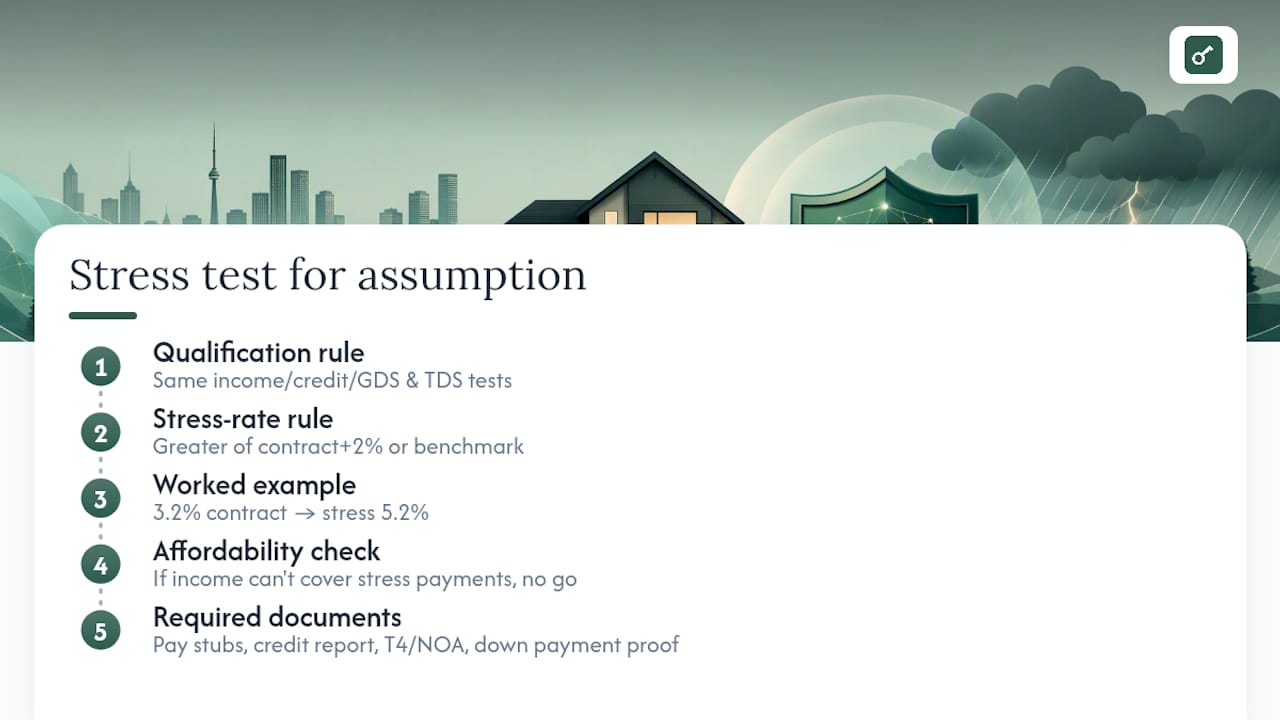
Yes, and this trips up more buyers than anything else in the process. A buyer assuming a mortgage has to qualify under the same income, credit, and debt ratio tests (GDS and TDS) as anyone applying for a brand-new mortgage. There's no shortcut because the rate looks attractive.
The FCAC's mortgage qualification tool confirms lenders qualify borrowers at the greater of the contract rate plus 2%, or the federal benchmark rate. Say the assumed mortgage carries a 3.2% rate from 2021. If the buyer's income can't support payments at that stress-tested rate, the low nominal rate on paper becomes irrelevant. Lenders will want recent pay stubs, a credit report, T4s or NOAs, and confirmation of the down payment or equity gap funds before they'll even schedule underwriting.
What is the equity gap, and how do you cover it?
The equity gap is the difference between the purchase price and the remaining mortgage balance the buyer is assuming. If a home sells for $650,000 and the assumable mortgage balance sits at $420,000, the buyer needs to come up with $230,000 through some combination of cash, a second mortgage, or a seller take back (VTB).
Cash is cleanest, verified savings or RRSP Home Buyers' Plan funds carry no extra interest cost. A second mortgage or private gap loan typically runs several points above the assumed rate, which can quietly erase the savings the assumption was supposed to deliver. Before committing, run the blended cost of the assumed rate plus the gap financing rate through a mortgage payment calculator and compare that number against a straightforward new mortgage at 2026 rates.
What happens to the seller if the buyer defaults later?
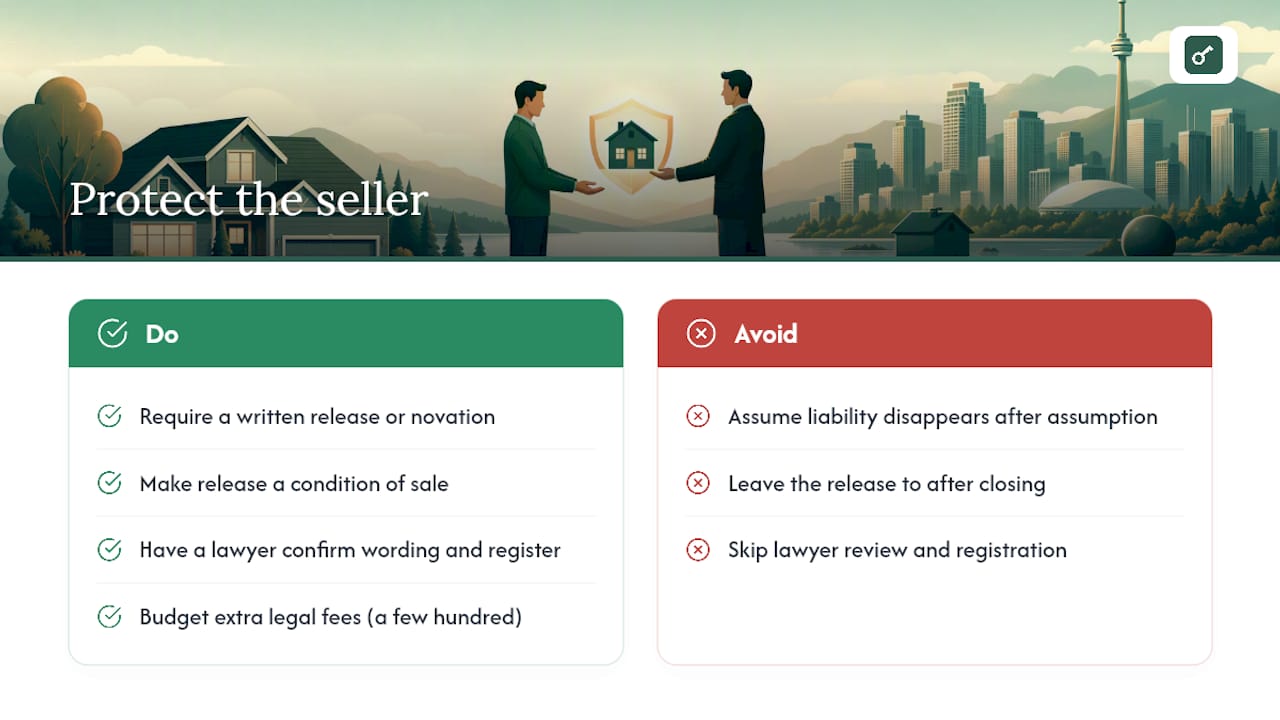
The seller's exposure doesn't disappear just because the buyer moved in and started making payments. Under Canadian mortgage law, sellers stay liable for the debt unless the lender formally issues a release of covenant or novation, and that release has to happen in writing.
Without it, a defaulting buyer years down the road could leave the original seller on the hook for a mortgage they no longer control. Every seller entertaining an assumption should make the written release a condition of sale, not an afterthought handled after closing. A real estate lawyer needs to confirm the exact wording the lender requires and get it registered before funds change hands. Legal fees for this kind of transfer typically run a few hundred dollars more than a standard closing, largely because of the extra document review.
When does an assumption actually pay off?
An assumption tends to make financial sense when the gap between the assumed rate and current market rates is wide, the buyer can fund the equity gap with cash rather than expensive borrowing, and there's still meaningful time left on the mortgage term.
- A rate gap of 1.5 to 2 percentage points or more between the assumed rate and current offers, which is common when comparing loans from 2020 or 2021 against 2026 pricing.
- Equity gap funding that comes from savings, RRSP withdrawals, or low-cost sources instead of a high-interest second mortgage.
- At least two or three years remaining on the assumed term, since a mortgage expiring in six months barely justifies the paperwork.
- Lender willingness. Even when the contract technically permits assumption, some lenders decline routinely, and marketability can suffer if buyers hear "maybe" too often.
Pro Tip: Ask the seller's lender for their exact release-of-covenant wording before you write an offer. If they won't commit to it in writing early, that's your answer about how smoothly this deal will actually go.
How do you model an assumption with Costtoclose calculators?
Numbers settle arguments that gut feeling can't. Before you fall in love with a low assumed rate, run it through a few calculators and see what the real monthly cost looks like once the gap financing is factored in.
- Check the affordability calculator to see whether your income clears the GDS/TDS thresholds lenders apply during underwriting.
- Run the closing cost calculator to budget for legal fees, land transfer tax, and the lender's assumption fee.
- If a HELOC or second mortgage is covering part of the equity gap, model that separately with the HELOC calculator to see the blended cost.
Plug in the seller's rate, remaining balance, purchase price, and any second financing terms, then save the results and bring them to your lender or mortgage broker as a starting point for the real conversation.
Checklist before you offer on or accept an assumable mortgage
Get these confirmed on paper before the deal goes any further.
- Seller: pull the mortgage contract, contact the lender, and get written confirmation of assumability plus the fee schedule.
- Buyer: get pre-qualified, prove funds for the equity gap, and line up backup financing in case the lender says no.
- Both parties: insist on a written release of liability, hire a real estate lawyer, and budget for legal and lender fees.
- Add a financing contingency clause to the purchase agreement covering assumption denial.
When we tell readers to model it, not just hope for it
We see the same pattern too often: buyers and sellers agree on an assumption in principle, then discover the equity gap or the stress test kills the deal weeks before closing. That's an expensive way to find out.
Run the numbers before you write the offer, not after. Confirm assumability with the lender early, and get any release of liability in writing as a condition, not a formality.
— Costtoclose
Where Costtoclose fits into an assumption decision
Costtoclose is the tool you reach for once the lender confirms an assumption is technically on the table and you need to know whether it's actually worth pursuing. The mortgage payment calculator lets you set the assumed rate against a fresh mortgage quote side by side, so you're not guessing at the monthly difference.
Layer in the closing cost calculator to catch the legal and transfer fees an assumption adds on top of the usual closing costs, and the affordability calculator to stress test your income against GDS and TDS limits before you spend money on a lawyer. If a second mortgage is bridging the equity gap, run that separately and add the blended payment together. Once you have a number you trust, bring it straight to your lender or mortgage broker and ask them to confirm it against their own underwriting.
Sources
This explainer draws on FCAC mortgage guidance, the FCAC stress test tool, CMHC insurance rules, and current industry reporting on lender discretion.
FAQ
What are the downsides of assuming a mortgage?
The buyer still faces a full stress test and must cover any equity gap, often with costlier second financing, while the seller risks remaining liable for the debt without a written release of covenant.
Are there assumable mortgages in Canada?
Yes, mostly conventional fixed-rate mortgages from major lenders, though the lender must approve every transfer and many variable-rate or collateral-charge products don't qualify at all.
How hard is it to get a mortgage assumption approved?
It depends on lender discretion as much as contract wording; some lenders decline assumptions even when the mortgage is technically assumable, and the buyer must still clear full underwriting and the stress test.
Can you assume a mortgage you're already a co-borrower on?
Generally no in the way most buyers expect. Removing one co-borrower and adding another still counts as a transfer that requires lender approval, underwriting of the remaining and incoming borrowers, and typically a formal assumption or refinance process.
Recommended
- Mortgage Refinance Calculator Canada (2026)
- Canadian Mortgage Affordability Calculator (2026)
- Mortgage Penalty Calculator Canada (2026)
This article is only for educational purposes and not a financial advice. Do your own due diligence and do not base your financial decisions on any this article.