
A mortgage discharge fee is what your lender charges to remove its claim from your property's title once you sell, refinance with a new lender, or pay off the mortgage entirely. Expect the lender's own admin charge to run $0 to $400, with total discharge costs, including registration and legal fees, typically landing between $325 and $1,300. Straight renewals with your existing lender don't trigger this fee at all.
TL;DR:
- Discharge fees range from $325 to $1,300 when including lender admin costs, registration, and legal fees, with full payoffs having lower costs than refinancing or collateral charges.
- Homeowners must request a discharge after paying off or refinancing their mortgage, as the process involves several parties and typically takes a few days to weeks to complete.
- Fees are highly variable depending on province, with Ontario, British Columbia, Alberta, and Quebec each handling discharges through different systems and fee schedules.
- Saving money on discharge costs involves asking your lender for exact fees upfront, using promotion offers from new lenders, and bundling legal work if selling and buying simultaneously.
- It is not a prepayment penalty; discharge costs cover paperwork and title removal, while prepayment penalties can run into thousands if breaking a fixed-term mortgage early.
Table of Contents
- Quick cost snapshot: what you'll actually pay
- What is a mortgage discharge and when do you need one?
- Who's involved and how the discharge process works
- Detailed cost breakdown: every charge explained
- Provincial variations you need to know about
- How to cut your discharge costs
- Estimating your real numbers before you commit
- A quick practical takeaway
- Where to estimate your discharge and closing costs
- Authoritative places to confirm exact fees
- Sources
- FAQ
Quick cost snapshot: what you'll actually pay
Before digging into the mechanics, here's the shape of the bill. Most homeowners underestimate this because they only think about the lender's line item and forget the registry and legal costs stacked on top.
- Lender admin/discharge fee: typically $0 to $400, with big banks often posting fees in the mid $200s to mid $300s (TD, for example, lists $340).
- Provincial registration fee: usually $70 to $250 depending on the province and registry system.
- Lawyer or notary fees: commonly $150 to $500, sometimes more if a collateral charge or HELOC is involved.
A simple full payoff with no complications might total around $325 to $500. A lender switch involving a collateral charge, extra legal review, and courier fees can push the total closer to $1,000 to $1,300.
What is a mortgage discharge and when do you need one?
A discharge is the legal step that removes your lender's registered interest from your property's title. Until that happens, the lender technically still holds a claim on the home, even if you've paid off every dollar you owe.
You need one in three common situations: selling the property, switching to a new lender at renewal, or refinancing with a different institution. Full payoff before your term ends, whether from a windfall or downsizing, also requires a formal discharge.
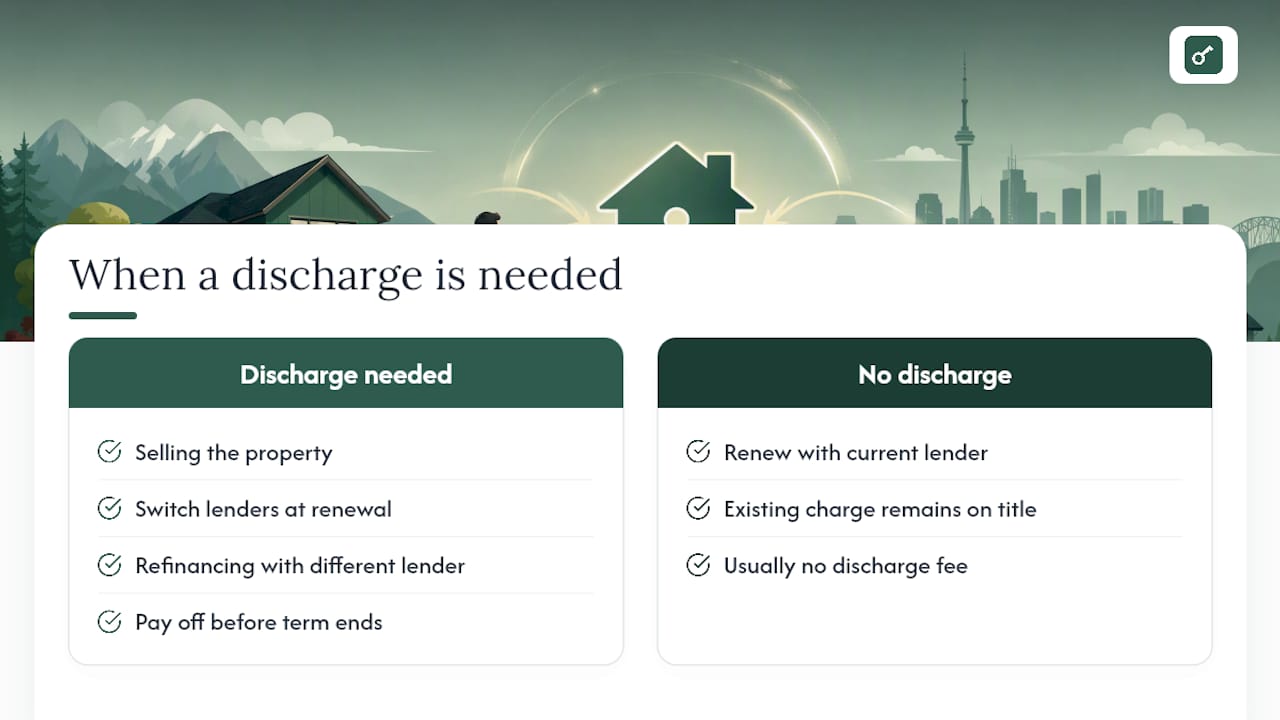
Renewing with your current lender is different. If you're staying put and simply signing a new term with the same bank, there's usually no discharge involved and no fee attached, because the existing charge on title stays in place. The confusion trips up a lot of homeowners who assume any mortgage paperwork means a discharge fee is coming.
Who's involved and how the discharge process works
Four parties typically touch a discharge: you as the borrower, your outgoing lender, a lawyer or notary, and the provincial land title registry. Each has a specific job, and missing a step is what causes delays.
- Request a payout statement from your current lender, showing the exact balance owed as of your closing or payoff date.
- Arrange for your lawyer or notary to receive the funds and coordinate with the lender's legal team or solicitor.
- The lender issues a discharge document once funds clear, authorizing removal of their interest.
- Your lawyer files the discharge with the provincial land title registry, officially clearing the charge.
- The registry confirms the discharge, usually through written confirmation or an updated title record.
The Financial Consumer Agency of Canada notes that a lawyer or notary typically coordinates and registers the discharge with the land registry, so this isn't a step you handle solo. Timing usually runs a few days to a few weeks, depending on how quickly your lender processes the payout.
Detailed cost breakdown: every charge explained
Your payout statement will list several line items, and knowing what each one covers helps you spot an error before it costs you money.
Lender discharge/admin fee. This covers the lender's internal paperwork and legal filing to release its claim. Posted fees among major banks tend to sit in the mid $200s to mid $300s, though some monoline lenders charge less. If you have a HELOC or a collateral charge stacked on your mortgage, expect the fee to run higher, since each account tied to the charge needs its own closure request. Paying off the principal alone doesn't automatically remove a bundled HELOC from title.
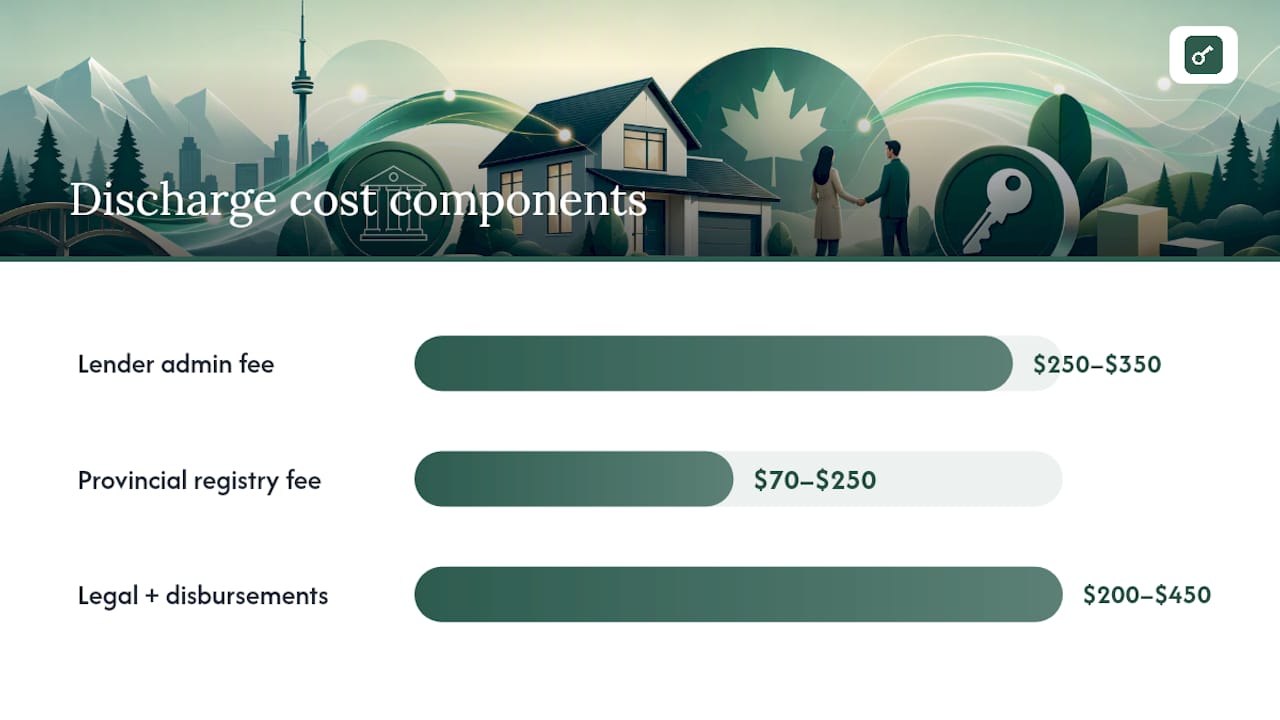
Provincial registration fee. Every land title registry charges a filing fee to process the discharge. These are set by provincial systems, not your lender, and vary from around $70 in some provinces to $250 in others.
Lawyer or notary fees and disbursements. This is often the biggest wildcard. Straightforward payoffs might cost $150 to $300 in legal fees. Add courier charges, trust account fees, and title searches, and disbursements can tack on another $50 to $150.
Total discharge costs typically run $325 to $1,300, according to NerdWallet Canada's breakdown of lender admin fees, registration costs, and legal charges combined.
One distinction trips up almost everyone: a discharge fee is not a prepayment penalty. The discharge fee pays for paperwork and title clearing. A prepayment penalty is a separate charge some lenders apply when you break a fixed-rate term early, and it can run into the thousands depending on your remaining term and rate differential. Both can apply on the same transaction if you're breaking a mortgage mid term and switching lenders. Run the numbers on the Mortgage Penalty Calculator so you don't mistake one for the other.
Provincial variations you need to know about
Land title systems are provincial, not federal, so registration steps and costs shift depending on where the property sits. Ontario runs discharges through the Teraview electronic registration system, while British Columbia uses the Land Title and Survey Authority. Alberta has its own provincial land registry with separate fee schedules.
- Ontario: electronic filing through Teraview keeps registration relatively fast, with fees generally in the low hundreds.
- British Columbia: LTSA handles registration, and fees are posted on the authority's own site.
- Alberta: the provincial land registry sets fees directly, checkable before you commit to a closing date.
- Quebec: notaries handle real estate discharges rather than lawyers, and notarial costs there tend to run higher than the legal fees charged in common law provinces.
Always confirm exact posted fees with your provincial registry rather than relying on a national average.
How to cut your discharge costs
A few moves can trim the total bill before you sign anything.
- Ask your lender directly for their posted discharge fee in writing, ideally before you commit to a closing date.
- Check switch promotions from your incoming lender. Many cover appraisal costs, legal fees, and a capped portion of your outgoing lender's discharge fee, though promo caps rarely cover collateral-charge legal work in full.
- Bundle your legal work. If you're selling and buying at once, using the same lawyer or notary for both transactions often reduces the combined bill versus hiring separately.
- Gather documents early: your mortgage statement, government ID, and property address, so your lawyer isn't chasing paperwork and adding hours to the invoice.
Pro Tip: Call your lender's discharge department directly and ask if your mortgage includes a collateral charge or HELOC component. That single question can save you from a surprise few hundred dollars in extra legal fees at closing.
Estimating your real numbers before you commit
Reading fee ranges only gets you so far. Running your own numbers against your actual mortgage balance, province, and lender gives you a figure you can trust.
- Use the Closing Cost Calculator to combine lender, registry, and legal costs into one province-specific estimate.
- Try the Mortgage Refinance Calculator if you're weighing whether to switch lenders or stay put, since it lets you compare the discharge and switch costs against potential rate savings.
- Check the Mortgage Payment Calculator if you're considering rolling discharge costs into a new mortgage rather than paying them upfront.
Plugging in your own numbers across a stay, switch, and sell scenario usually reveals which option actually saves money once every fee is accounted for.
A quick practical takeaway
The biggest surprise homeowners run into isn't the fee itself. It's discovering the discharge doesn't happen automatically after final payment. You have to request it, and your lawyer has to file it. Before you close anything, pull your payout statement, confirm every fee line with your lender, and run your numbers through a calculator so nothing catches you off guard at the lawyer's office.
Where to estimate your discharge and closing costs
Costtoclose gives you a direct way to see your total discharge and closing costs before you're staring at a payout statement wondering where the extra $400 came from. Rather than guessing at provincial registration fees or piecing together lender admin charges from old forum posts, you plug in your own numbers and get a province-specific estimate in minutes.
If you're selling, start with the Forbearance Vs Deferment: What Sellers And Investors Must Know guide to understand timing and financial options alongside your discharge fee and other closing costs. If you're weighing a lender switch, the Refinance Calculator lets you compare staying versus switching once discharge and legal costs are factored in. Either way, you walk into your lawyer's office with a number you already trust, not one you're hearing for the first time on closing day.
Authoritative places to confirm exact fees
- FCAC's mortgage discharge guidance covers borrower rights and process.
- Alberta's land registry posts current registration fees and filing procedures.
Sources
- Discharging a mortgage
- Mortgage Discharge: What It Is, What You'll Pay - NerdWallet Canada
- Discharge Fees by Lender 2026 — TD $340, Scotia, RBC
FAQ
Do I have to pay a mortgage discharge fee?
Yes, in most cases. Lenders charge an admin fee to process the paperwork that removes their interest from title, though renewing with the same lender typically avoids this cost.
Is there a fee to discharge a mortgage?
Yes. Lender admin fees usually run $0 to $400, with additional registration and legal costs on top.
How much does it cost to get out of a mortgage in Canada?
Total discharge costs, including the lender fee, provincial registration, and lawyer or notary charges, typically run $325 to $1,300. Breaking a fixed term early can add a separate prepayment penalty on top of that.
How much does RBC charge to discharge a mortgage?
Posted discharge fees among major Canadian banks, including RBC, generally fall in the mid $200s to mid $300s, though you should confirm the current figure directly with your lender since posted fees change.
Recommended
- Mortgage Penalty Calculator Canada (2026)
- Canadian Closing Cost & Land Transfer Tax Calculator
- Cost of Selling a Home in Canada Calculator
This article is only for educational purposes and not a financial advice. Do your own due diligence and do not base your financial decisions on any this article.