

The Smith Manoeuvre converts non-deductible mortgage interest into tax-deductible investment debt by pairing a readvanceable mortgage with a borrow-to-invest loop. It suits homeowners with substantial equity, a long time horizon, and a marginal tax rate high enough to make the deduction meaningful. The Canada Revenue Agency allows the strategy when borrowed funds are traceable to income-producing investments under paragraph 20(1)(c) of the Income Tax Act, but sloppy paperwork can undo the whole plan.
TL;DR:
- The strategy is most effective for homeowners with substantial equity, a long-term horizon, and high marginal tax rates, especially after maxing out registered accounts.
- Proper record-keeping and paper trail management are crucial, as sloppy documentation can disqualify the interest deduction under CRA rules.
- Market declines or rate hikes can significantly impact the strategy's profitability, requiring conservative leverage and regular tax reviews.
- The strategy offers limited benefit to those with taxable income under approximately $90,000, as the after-tax advantage may be too small for the added complexity.
- Building a solid plan involves choosing the right readvanceable mortgage product, consulting professionals, and running personalized calculations before implementation.
Table of Contents
- What is the Smith Manoeuvre and how does it work?
- What CRA rules govern interest deductibility?
- When does the Smith Manoeuvre actually make financial sense?
- What are the real risks and downsides?
- How do you actually set up the Smith Manoeuvre correctly?
- Which investments actually support the tax deduction?
- What does the math look like in a real scenario?
- How do you decide if this is right for you?
- Our take: sequence it right, or skip it
- Run your own numbers before you commit
- Sources
- FAQ
What is the Smith Manoeuvre and how does it work?
The Smith Manoeuvre runs on a single piece of mortgage plumbing: the readvanceable mortgage. This product pairs a standard amortizing mortgage with a home equity line of credit (HELOC) that automatically increases its limit as you pay down principal. Most big Canadian banks and several credit unions offer some version of this combined product, though the exact terms and fees vary a lot between lenders.
Here's the mechanical loop that makes the whole strategy tick:
- You make your regular mortgage payment. Part of it goes to interest, part to principal. The principal portion is the one that matters here.
- Your HELOC limit grows automatically. Because the mortgage is readvanceable, every dollar of principal you repay opens up an equivalent dollar of available HELOC credit. Pay down $600 in principal this month, and you unlock $600 in new borrowing room.
- You borrow that new room and invest it. The funds move directly into a dedicated non-registered investment account, typically holding dividend stocks, bond funds, or income-focused ETFs.
- You claim the HELOC interest as a tax deduction. Because the borrowed money was used to buy income-producing investments, the interest on that portion of debt qualifies under paragraph 20(1)(c) of the Income Tax Act.
- You get a tax refund and apply it to your mortgage. That refund goes straight against your mortgage principal, which frees up even more HELOC room next year, and the loop repeats.
Over years, the effect is a slow flip: your non-deductible mortgage debt shrinks while your deductible investment debt grows. Your total debt load doesn't necessarily fall faster than a conventional mortgage payoff, but a growing share of the interest you're paying becomes tax-deductible.
There are two common variants worth knowing. The classic readvanceable loop described above runs monthly or annually as principal payments accrue. A simpler variant uses a static HELOC lump sum. Some homeowners with an existing home equity line borrow the full available amount once, invest it, and claim the interest without ever setting up the automated readvance feature. This approach is less elegant and doesn't compound the same way, but it avoids some of the administrative complexity.
Before signing anything, ask your lender pointed questions. What's the combined loan-to-value limit on the readvanceable product, and does it change if home prices in your area drop? Are there redraw restrictions if you've paid down a large chunk of principal in one shot? Is the HELOC portion callable, meaning can the lender demand repayment or freeze the credit line under certain conditions? Those answers matter more than the advertised interest rate, because a frozen or reduced HELOC mid-strategy can strand your plan.
What CRA rules govern interest deductibility?
The legal foundation for the entire strategy sits in one sentence of federal tax law. Paragraph 20(1)(c) of the Income Tax Act permits a deduction for interest on money borrowed for the purpose of earning income from a business or property. The word "purpose" is doing a lot of work in that sentence, and the CRA's Income Tax Folio S3-F6-C1 spells out how that purpose gets tested.
The core requirement is direct use, often called tracing. The CRA wants to see an unbroken line from the borrowed dollar to an income-producing investment. That means:
- Every HELOC draw needs a matching transaction into a dedicated non-registered investment account, never a chequing account used for groceries or vacations.
- Trade confirmations from your brokerage should line up in date and amount with the HELOC withdrawal that funded them.
- Mixing borrowed and personal funds in one account, even briefly, can taint the whole balance and jeopardize the deduction on the entire amount, not just the mixed portion.
CRA generally expects taxpayers to retain supporting records for at least six years after the relevant tax year, covering HELOC statements, trade confirmations, and account records that prove the tracing chain. If you're audited five years in and can't produce a clean paper trail, the deduction can be reassessed retroactively, with interest and penalties layered on top.
There's also a subtler tracking concept worth understanding: the cumulative net investment loss, or CNIL. This running tally captures the gap between your investment expenses (including deductible interest) and your investment income over the years. A large CNIL balance can restrict your ability to claim the capital gains exemption on other property down the road, so it's not a number to ignore just because it doesn't show up on your annual notice of assessment in a prominent way.
Two court cases shape how practitioners think about this strategy. In Singleton v. Canada, the Supreme Court accepted a structured series of transactions that separated a legal partnership withdrawal from a mortgage borrowing, allowing interest deductibility even though the economic effect resembled borrowing against a home. In Lipson v. Canada, the same court applied the general anti-avoidance rule against a spousal loan arrangement designed primarily to shift income for tax purposes, signalling that structure alone doesn't guarantee success if the CRA views the arrangement as abusive. The lesson from both: form matters, but so does substance, and a paper trail that looks engineered purely to dodge tax invites scrutiny.
When does the Smith Manoeuvre actually make financial sense?
The tax logic behind this strategy rests on an asymmetry most homeowners never think about. Mortgage interest on your home is not deductible under normal circumstances. Investment interest on money borrowed to earn income can be. Meanwhile, if that borrowed money buys Canadian dividend stocks, you get preferential tax treatment through the dividend tax credit, and capital gains are only half taxed. You're deducting at your full marginal rate while your investment returns get taxed at a discount.
That asymmetry only becomes meaningful at certain income levels. Below that, particularly for taxable income under roughly $90,000, the after-tax spread between deductible interest and investment returns is often too thin to justify the added complexity and risk.
Here's what makes the loop compound over time:
- Your annual tax refund from the HELOC interest deduction goes directly against your mortgage principal, not into your pocket for spending.
- Extra principal paydown means more HELOC room opens up next year, which means a larger deductible investment position.
- Over a decade or more, this creates a snowball effect where your investment portfolio and your deductible debt both grow, while your non-deductible mortgage balance shrinks faster than it would under standard amortization alone.
One sequencing point gets missed constantly. Before you touch HELOC leverage, max out your TFSA and RRSP room first. Registered accounts offer tax sheltering or deferral without any leverage risk at all. Only after that room is exhausted does borrowing against your home to invest in a taxable account start to make sense as the next lever to pull.
What are the real risks and downsides?
Every benefit described above assumes rates stay manageable and markets cooperate. Neither assumption is guaranteed, and the risks here are not theoretical.
Interest-rate exposure is the most immediate one. HELOC rates float with prime, and the spread lenders charge over prime can widen during tighter credit conditions. If your HELOC rate climbs a couple of percentage points, the interest cost on your leveraged position rises immediately, while your investment returns don't adjust on the same schedule. The deduction softens the blow but doesn't eliminate it.
Market risk compounds that problem. You're borrowing to invest in equities or income funds that can drop in value, sometimes sharply, in the same year rates rise. If you're forced to sell during a downturn, whether due to a life event or a margin-style pressure from your lender, you lock in losses on money you borrowed against your home.
A few other constraints deserve equal weight:
- Lenders and OSFI guidelines generally cap combined mortgage and HELOC borrowing around 65% to 80% of your home's value, which limits how much room you'll ever have to work with.
- Committing your HELOC room to a leveraged investment strategy reduces your flexibility to use that same credit for a renovation, a business opportunity, or an emergency.
- A large CNIL balance built up over years of claimed interest can restrict your capital gains exemption eligibility on other property sales later.
- Life events change the calculus fast. A job loss, a move, or a divorce can force decisions about the leveraged position at the worst possible time.
If that scenario forced you to sell investments or strain your monthly cash flow, your leverage level is too aggressive.*
How do you actually set up the Smith Manoeuvre correctly?
Getting the structure right from day one avoids most of the compliance headaches that show up later. Treat this as a build sequence, not a checklist to skim.
- Shop for the right readvanceable mortgage product. Not every lender offers one, and terms vary meaningfully. Compare the combined loan-to-value ceiling, whether the HELOC portion is callable, redraw restrictions after large principal payments, and any annual or setup fees tied to the readvance feature.
- Open a dedicated non-registered investment account. This account exists for one purpose: holding the borrowed funds and nothing else. Never route personal savings, a bonus, or a tax refund unrelated to the strategy through this account, since that mixing can compromise your tracing documentation.
- Set up a direct transfer path from HELOC to investment account. The cleanest audit trail comes from a HELOC withdrawal that moves straight into the brokerage account on the same day or within a tight window, with no stop at a chequing account in between.
- Build your record-keeping system before you make the first trade. Save every HELOC statement, every trade confirmation, and every T5 or T3 slip generated by the investment income. Keep records for a minimum of six years past the relevant tax year, and consider a simple spreadsheet that logs each draw amount, date, and corresponding investment purchase.
- File the appropriate tax forms each year. Interest deductions and any capital gains or losses from the investment account need to be reported accurately, and a T936 cumulative net investment loss calculation should be updated annually to track your CNIL balance.
Three professionals typically need to be involved, and each has a distinct role:
- A mortgage broker who understands readvanceable products across multiple lenders, not just their bank's proprietary version, so you can compare terms objectively.
- A tax accountant familiar with paragraph 20(1)(c) tracing requirements, ideally one who has prepared returns for other clients running this exact strategy.
- An investment advisor or discount brokerage who can help you select income-producing holdings appropriate for a leveraged, taxable account rather than growth-only assets that won't support the deduction.
Ask your mortgage broker directly whether the HELOC portion is callable and under what conditions. Ask your accountant how they'll document the tracing chain if you're audited. Ask your investment advisor whether the proposed portfolio yield is realistic after fees, not just before them.
Which investments actually support the tax deduction?
The CRA's test isn't about what kind of investment you choose. It's about whether that investment has a reasonable expectation of producing income. That single distinction determines which assets belong in a Smith Manoeuvre account and which ones create tax risk.
Dividend-paying Canadian equities are the most common choice, largely because they generate a visible, regular income stream that clearly supports the "purpose" test in paragraph 20(1)(c). Income-focused ETFs, bond funds, and REITs work for the same reason: they distribute cash regularly, which gives the CRA a clean line between the borrowed money and taxable income earned.
Growth-only assets sit in murkier territory. A stock that pays no dividend and is held purely for capital appreciation may still qualify in some circumstances, but the CRA's folio leans toward income-producing purpose being the safer, clearer path. Registered accounts are off the table entirely for this strategy. Investments held inside a TFSA or RRSP don't generate taxable income in your hands the same way, so interest on money borrowed to invest inside those accounts doesn't meet the deductibility test.
A few practical guidelines round out a sensible portfolio approach:
- Diversify across sectors and asset types rather than concentrating in one or two dividend stocks, since a leveraged position amplifies concentration risk.
- Watch management fees closely. A 2% fee on a leveraged portfolio erodes your after-tax hurdle rate faster than the same fee on an unleveraged account.
- Remember that taxable distributions, including capital gains distributions from mutual funds, generate a tax bill even in years when the fund's price drops.
- Size the leveraged portion conservatively relative to your total net worth and income stability, not just relative to your available HELOC room.
What does the math look like in a real scenario?
Numbers make this strategy concrete in a way that theory can't. Here's a simplified one-year illustration using rounded, realistic figures for a homeowner in a higher tax bracket.
Assume a homeowner pays $8,000 in mortgage principal over the year, which opens up $8,000 in new HELOC room. They borrow that $8,000 and invest it in a diversified income portfolio yielding 4% annually.
The arithmetic runs like this:
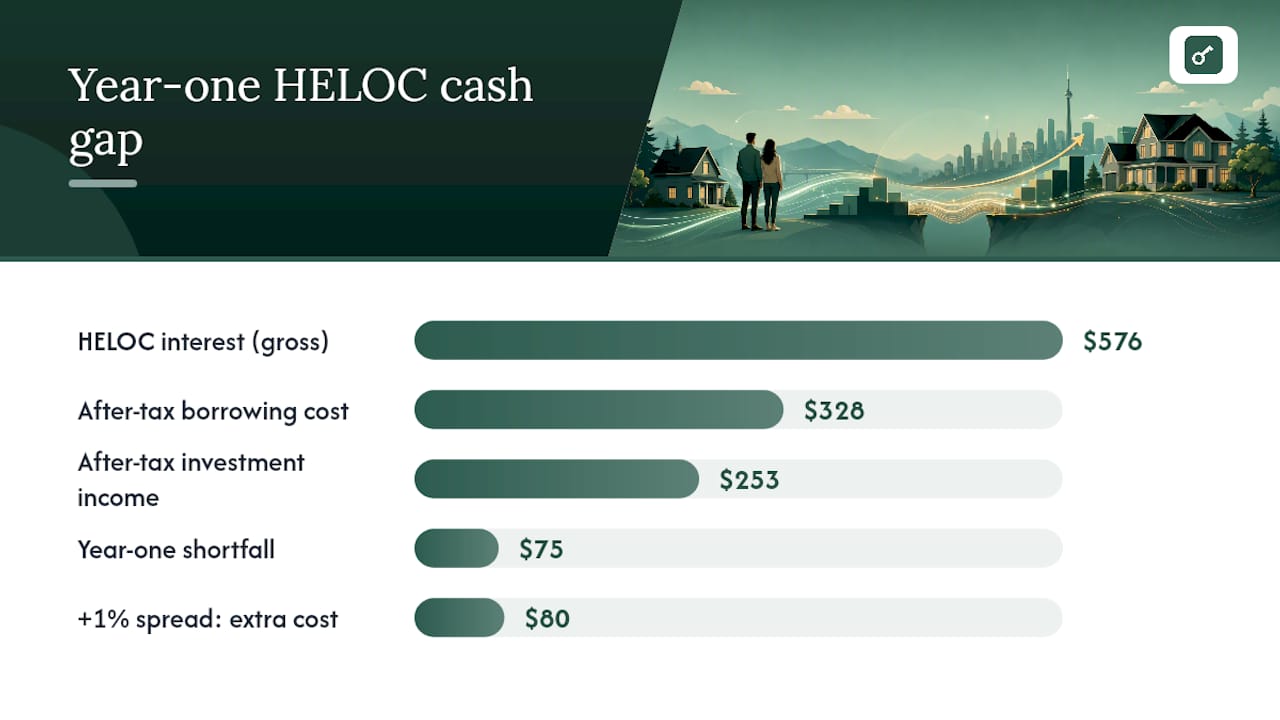
- The homeowner pays $576 in HELOC interest for the year on the newly borrowed $8,000.
- That $576 is fully deductible, generating a $248 tax refund at the 43% marginal rate.
- The refund gets applied directly to mortgage principal, accelerating the payoff of the non-deductible debt.
- The $320 in investment income is taxed favourably (dividend tax credit assumed), leaving roughly $253 after tax.
- Comparing the after-tax investment income ($253) against the after-tax cost of borrowing ($576 minus the $248 refund, or $328), the homeowner is short by about $75 in year one, before accounting for any capital appreciation in the portfolio.
That gap is the after-tax hurdle. It means the portfolio needs some capital growth on top of its yield, or a higher yield, or a lower borrowing spread, to break even in cash-flow terms in year one. Over many years, as HELOC room compounds and markets typically trend upward over long periods, the picture usually improves, but year one rarely looks dramatically profitable on paper.
Sensitivity matters enormously here. Push the HELOC spread up by a full point, and the annual interest cost jumps by roughly $80, again widening the shortfall. This is exactly the kind of scenario worth testing with a HELOC calculator using your own numbers rather than relying on a generic example, since your rate, your tax bracket, and your portfolio yield will all differ from the illustration above.
How do you decide if this is right for you?
Run through this eligibility checklist honestly before you open a single new account:
- You have substantial home equity, typically enough to generate meaningful HELOC room after a readvanceable mortgage is set up.
- Your investment horizon is long, generally ten years or more, since short-term market swings can derail the strategy if you need to unwind it early.
- Your marginal tax rate sits well into the higher brackets, making the deduction financially significant rather than marginal.
- You've already maxed out your TFSA and RRSP contribution room, or have a specific reason to prioritize non-registered leverage instead.
- You maintain a solid emergency reserve outside the strategy, so a job loss or unexpected expense doesn't force you to unwind a leveraged position at a bad time.
Certain red flags should stop the plan cold, or at least pause it until they're resolved. Carrying high-interest consumer debt, like credit card balances, while simultaneously taking on investment leverage is almost always the wrong sequencing; pay that debt off first. A time horizon under five years leaves too little room for markets to recover from a downturn before you might need to unwind the position.
A conservative approach caps the leveraged portion of your HELOC utilization well below the maximum available, leaving buffer room for rate increases or market drops. Bring specific questions to each advisor: ask your CPA how they'll defend your tracing documentation in an audit, ask your mortgage broker what happens to your HELOC limit if home values in your area decline, and ask your investment advisor how the proposed portfolio would have performed during the 2008 or 2020 market drops.
Our take: sequence it right, or skip it
Most articles on this topic sell the tax deduction as the headline benefit. We'd rather you think about sequencing first. TFSA and RRSP room should be exhausted before HELOC leverage enters the conversation, full stop. Those accounts offer real tax advantages with zero leverage risk, and too many homeowners jump to the Smith Manoeuvre because it sounds sophisticated, while ignoring cheaper, safer room sitting unused.
Treat your HELOC as strategic reserve capital, not a default savings vehicle. The behavioural risk here is real: leverage feels fine until a rate hike and a market drop hit in the same year, and the temptation to panic sell is strongest exactly when your paper trail and your nerves are both under the most pressure.
Annual tax review isn't optional maintenance, it's the backbone of the entire strategy. Revisit the numbers every single year, not just when you set the structure up.
— Costtoclose
Run your own numbers before you commit
There are other ways to access home equity, from a straight refinance to a second mortgage to simply selling and downsizing. The Smith Manoeuvre is a specific, ongoing structure, and it only makes sense once you've modelled your own numbers rather than someone else's example. Costtoclose gives you free calculators built for exactly this kind of scenario testing, using your actual rate, your actual income, and your actual equity position instead of a rounded illustration.

Start with the HELOC calculator to see how much borrowing room a readvanceable mortgage would realistically open up as you pay down principal. If you're weighing whether to refinance into a readvanceable product first, the mortgage refinance calculator shows the costs and penalties involved before you switch lenders or restructure. And if capital gains from an eventual portfolio sale are part of your long-term plan, the capital gains tax calculator helps you see the tax consequences ahead of time rather than at filing season. None of these replace a conversation with a tax accountant who knows your full picture, but they'll get you into that conversation with real numbers instead of guesses.
Sources
The legal backbone of this strategy comes from two government sources: paragraph 20(1)(c) of the Income Tax Act, which confirms interest on money borrowed to earn income from property can be deducted, and CRA's Income Tax Folio S3-F6-C1, which lays out the direct-use tracing test in detail.
For practical implementation and threshold guidance, Pragmatic Mortgage's Smith Manoeuvre guide walks through product setup and record-keeping specifics. The Globe and Mail's coverage offers a candid journalistic assessment of who actually benefits and where practitioners see the strategy go wrong. SovereignCanadian's deep dive covers sequencing logic and the behavioural costs of committing HELOC room long term.
This article is general information, not a substitute for advice from a qualified financial advisor. Consult a qualified financial professional about your own circumstances before acting on anything here.
- Canada
- Income Tax Act — section 20(1) (interest deductibility) — Justice Laws Website
- Smith Manoeuvre Canada: Tax Strategy, Readvanceable Mortgage Guide & Risks — Pragmatic Mortgage
FAQ
Is the Smith Manoeuvre legal in Canada?
Yes. The strategy relies on paragraph 20(1)(c) of the Income Tax Act, which permits interest deductions on money borrowed to earn income from property, provided the funds are properly traced to income-producing investments.
What happens to the Smith Manoeuvre if I sell my house?
Selling your home typically requires paying off both the mortgage and the HELOC balance from the proceeds, which ends the interest deduction going forward; any investments held in the non-registered account continue independently and remain subject to normal capital gains rules on eventual sale.
Can I use my TFSA or RRSP with the Smith Manoeuvre?
No, investments held inside a TFSA or RRSP don't qualify for the interest deduction because they don't generate taxable income in your hands, which is why financial commentators recommend maxing registered room first before turning to HELOC leverage.
Can Costtoclose help me model a Smith Manoeuvre scenario?
Costtoclose's HELOC calculator and mortgage payment calculator let you test your own rate, equity, and payment assumptions, though you should confirm the tax treatment with a qualified accountant before implementing anything.
Recommended
- RRSP Home Buyers' Plan Calculator (2026)
- Mortgage Penalty Calculator Canada (2026)
- Canadian Closing Cost & Land Transfer Tax Calculator (2026)
- Capital Gains Tax Calculator — Investment Property (2026)
This article is only for educational purposes and not a financial advice. Do your own due diligence and do not base your financial decisions on any this article.