
The underused housing tax is gone for 2026 and every year after 2024, but that repeal doesn't erase what happened before it. If you owned residential property on December 31 of 2022, 2023, or 2024 and weren't automatically excluded, you may still owe a return, a payment, or both. The immediate move is simple: check your ownership status for each of those three years and, if you haven't filed, start gathering records now.
TL;DR:
- Affected property owners still face potential liability for 2022 to 2024, requiring proper valuation, exemption proof, and timely filing despite the 2025 repeal.
- Multiple ownership capacities for a single property can necessitate separate returns, increasing complexity and risk of missed filings.
- Penalties for late or missed filings include significant fixed fees, accruing interest, and no legal time limit for CRA assessments.
- Municipal vacancy taxes are separate from the federal UHT, with different rules, rates, and deadlines that owners must verify independently.
- Use calculators and gather records now to estimate exposure and prepare for possible liabilities before the upcoming filing deadlines.
Table of Contents
- Who has to file a UHT return for those years?
- What Budget 2025 actually changed
- How to calculate and file for 2022 to 2024
- Which exemptions actually apply, and how do you prove them?
- What happens if you never filed for 2022 to 2024?
- Is this the same as my city's vacant home tax?
- Turning this into a checklist you can actually use
- Why the repeal doesn't mean you're off the hook
- Estimate your exposure before you file
- Where to check the official rules yourself
- Sources
- FAQ
Who has to file a UHT return for those years?
The federal government splits property owners into two camps: excluded owners and affected owners. Only the second group has any paperwork to worry about, and the split hinges on who you are, not what the property is worth.
An excluded owner is generally a Canadian citizen or permanent resident who owns property in their own name (not through a corporation, trust, or partnership), along with most public companies, registered charities, and government bodies. If you fall into this category, you had no UHT filing or payment obligations for 2022 through 2024, full stop.
An affected owner is everyone else with legal title on December 31 of the relevant year: non-resident, non-citizen individuals; most private corporations, even Canadian-owned ones; trustees; and partners in a partnership. Affected owner status doesn't automatically mean you owe tax. It means you had to file Form UHT-2900, even if an exemption brought your bill to zero.
A few common scenarios illustrate the split:
- A Canadian citizen who owns her cottage personally: excluded owner, no filing required.
- The same cottage held inside a family trust: the trustee is an affected owner and must file, even if a beneficiary lives there.
- A private corporation holding a rental condo, regardless of who owns the shares: affected owner, filing required.
- A property owned jointly by two people in different capacities (say, personally and as a bare trustee for someone else): each capacity typically needs its own return.
That last point trips up more owners than anything else. If you hold the same property in more than one capacity, CRA guidance treats each capacity separately, which can mean multiple returns for a single address.
What Budget 2025 actually changed
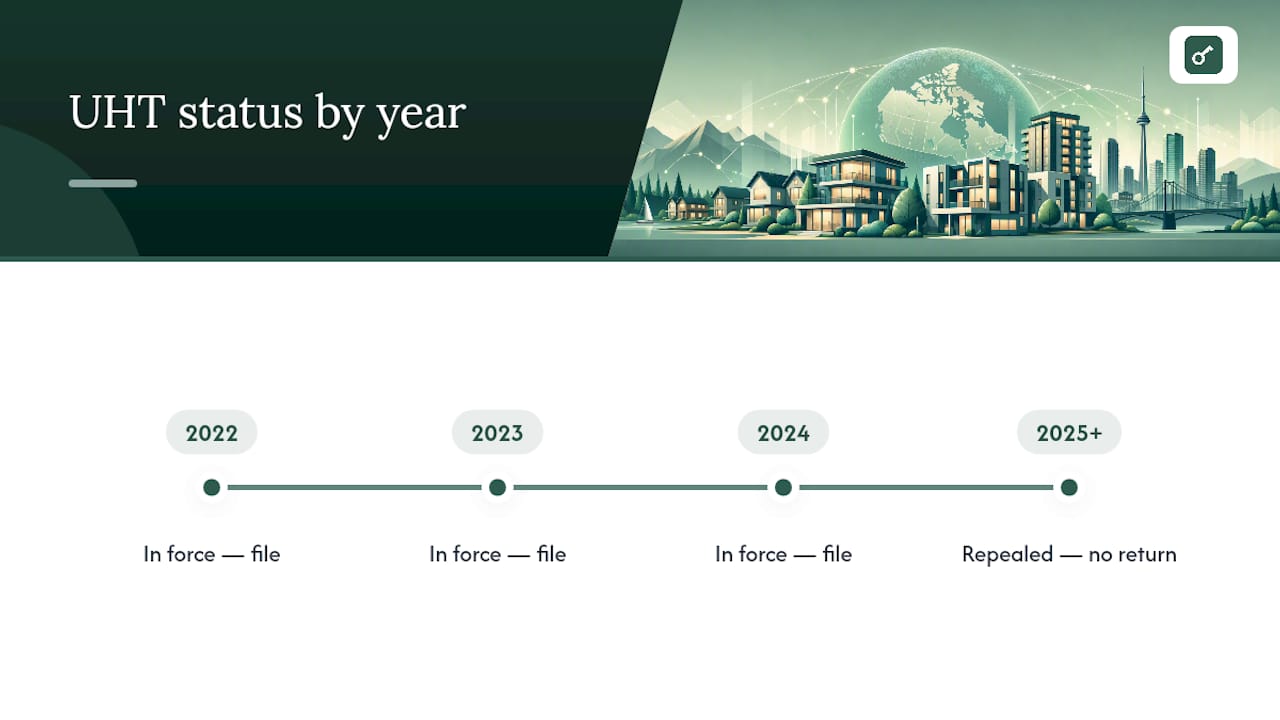
The tax is not just quiet for 2026, it is legally dead going forward. Following royal assent of the Budget 2025 Implementation Act on March 26, 2026, the underused housing tax was eliminated for the 2025 calendar year and every year after it. No UHT return, no UHT payment, for 2025 onward.
What this repeal does not do: erase 2022, 2023, or 2024 liability. The Underused Housing Tax Act still governs those three years exactly as written when the tax was in force. If you were an affected owner in any of them and haven't filed, that obligation sits on the books today, waiting for a return.
If you're catching up now, treat each of the three years as its own filing, with its own ownership snapshot, its own exemption analysis, and its own deadline that has technically already passed.
How to calculate and file for 2022 to 2024
The complexity lives entirely in choosing the tax base and getting the paperwork right.
- Pick your valuation. Default to the property's taxable value, usually the most recent municipal assessment or purchase price, whichever the CRA rules treat as taxable value for that year.
- Consider the fair market value election. You can elect to use FMV instead, but it requires a written appraisal from an accredited, arm's length appraiser, determined on or before April 30 following the calendar year. This sometimes lowers your bill, sometimes doesn't, so it's worth running both numbers before committing.
- Apply ownership percentage. If you own 50% of a property, you owe 1% of 50% of the taxable value, not the full amount.
- File Form UHT-2900. One return per property, per ownership capacity, for each applicable year. You'll need your Social Insurance Number, Individual Tax Number, Trust Account Number, or Business Number depending on how you hold title.
- Meet the deadline. Returns were due April 30 of the following year, so 2024's return was due April 30, 2025. Late doesn't mean impossible. It means penalties are already accruing.
Pro Tip: Keep your municipal assessment notice, any appraisal report, and occupancy records (leases, utility bills, travel records) in one file per property per year. CRA record retention expectations run to roughly six years, and reconstructing this after the fact is far harder than saving it as you go.
Which exemptions actually apply, and how do you prove them?
Even affected owners frequently owe nothing, because the exemption list is broad. The catch is that every exemption needs supporting evidence, not just a checked box.
- Primary place of residence: applies only to individuals, and only when the property was genuinely your main home.
- Qualifying occupancy: if a tenant occupied the property for at least 180 days under a documented arrangement, this can exempt the return.
- Vacation property: available for properties in eligible rural or recreational areas, subject to prescribed location and personal-use conditions.
- Uninhabitable or under renovation: exemptions exist for properties that were genuinely unfit to live in for a defined stretch of the year.
- New ownership or death of an owner: short-term exemptions cover the year a property changed hands or an owner passed away.
Whichever exemption you claim, keep the receipts. Lease agreements, renovation permits, contractor invoices, and dated photos all matter more than your memory of what happened in 2023. The CRA's technical notices on qualifying occupancy specifically flag the 180 day threshold as the number auditors check first.
What happens if you never filed for 2022 to 2024?
Missing a UHT deadline doesn't age off the way some tax matters do. There's no limitation period protecting an unfiled return, which means the CRA can assess it years from now, with penalties and interest compounding the whole time.
- Minimum penalty: $1,000 for individuals, $2,000 for corporations and other non-individuals, per return, per year.
- Additional late-filing penalties are calculated as a percentage of the tax owing, layered on top of the flat minimum.
- Interest accrues on unpaid tax from the original due date, not from whenever you finally file.
Pro Tip: If you suspect you owe for more than one year, file the oldest year first and work forward. It establishes a clean compliance trail and often reduces the appearance of deliberate non-compliance if CRA does review your file.
Gather your ownership records, run the numbers, and file the late returns rather than waiting for a notice to force the issue.
Is this the same as my city's vacant home tax?
No, and mixing them up is one of the most common and costly mistakes owners make. The federal UHT and municipal or provincial vacancy taxes are entirely separate regimes, run by different authorities, with different rules and different deadlines.
- Toronto's Vacant Home Tax, Vancouver's Empty Homes Tax, and BC's provincial speculation and vacancy tax all operate independently of the federal system.
- Repeal of the federal tax for 2025 onward changes nothing about your municipal or provincial obligations.
- Always check your specific city or provincial program directly, since thresholds and exemptions differ from the federal rules.
Turning this into a checklist you can actually use
Compliance gets manageable once you break it into steps rather than treating it as one big unknown.
- List every property you owned on December 31 of 2022, 2023, and 2024, and note the capacity in which you held each one.
- Determine affected or excluded status for each property, in each year, separately.
- Pull the supporting records: assessment notices, appraisals if electing FMV, occupancy or tenancy documents.
- Decide taxable value versus FMV for any year where an exemption isn't a clean fit.
- File Form UHT-2900 for any outstanding year where you were an affected owner.
Costtoclose's Vacant Home Tax Calculator can help you model what a 1% liability looks like against your property's value before you commit to a filing position. If you're weighing whether to sell instead of untangling multiple years of history, the capital gains calculator shows the tax side of that decision too. For anything involving a trust, partnership, or a valuation dispute, bring in a tax professional rather than relying on a calculator alone.
Why the repeal doesn't mean you're off the hook
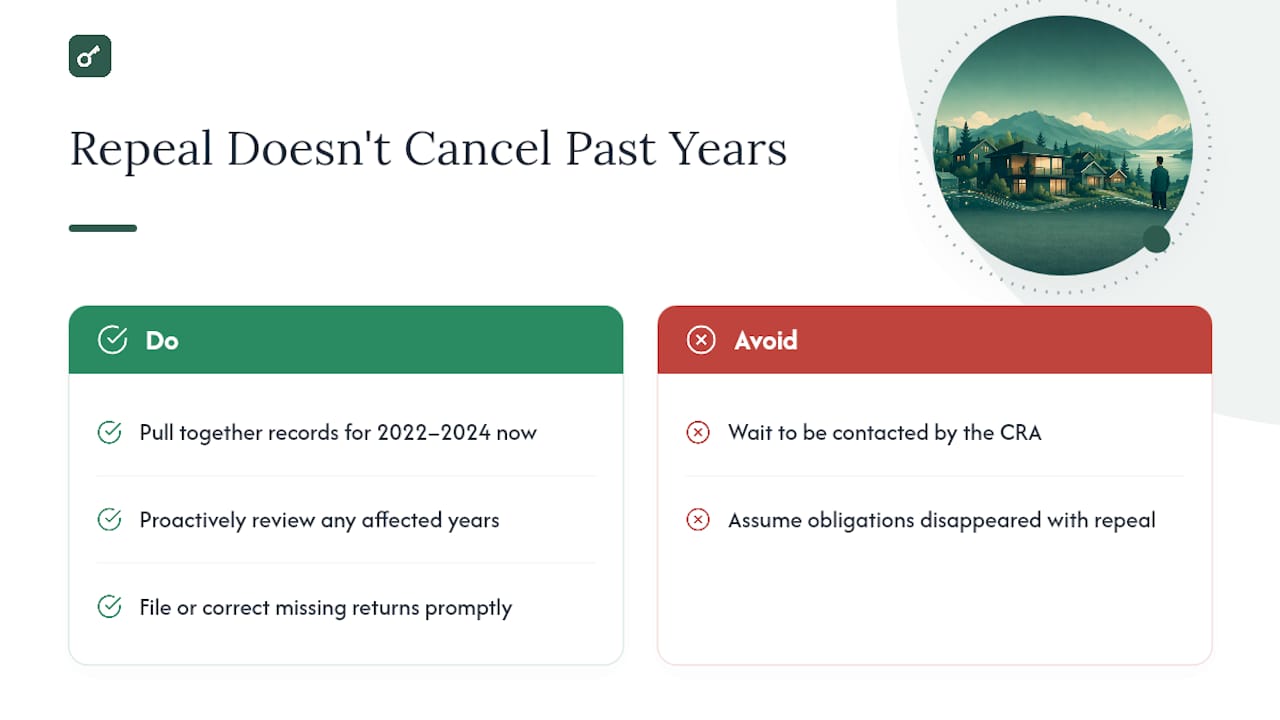
Owners keep asking us whether the 2025 repeal means old obligations quietly disappeared. They didn't. The CRA can still review 2022 through 2024 returns, and an unfiled year doesn't expire on its own.
If you were affected in any of those years, the smartest move is pulling your records together now, while they're still findable, rather than waiting for a letter to force the question.
— Costtoclose
Estimate your exposure before you file
If you're staring at three years of potential underused housing tax exposure and no clear sense of the dollar figure, Costtoclose gives you a faster starting point than piecing it together from CRA worksheets alone. Our Vacant Home Tax Calculator lets you plug in your property's value and ownership percentage to see what a 1% liability actually looks like for Toronto, Vancouver, or BC properties, historical or current.
If you're also weighing a sale to simplify your holdings, the Cost of Selling a Home Calculator and Capital Gains Tax Calculator map out the transaction costs and tax consequences side by side. None of these tools replace professional tax advice, especially for trust or corporate ownership, but they give you real numbers to bring to that conversation. Run your property through the calculator now and see where you actually stand before your next filing decision.
Where to check the official rules yourself
- CRA underused housing tax guidance: current filing rules and responsibilities.
- Underused Housing Tax Act text: the legislation itself, including the 2025+ repeal.
- CRA notice on filing and paying: penalty amounts and deadlines.
Sources
- Who must file a return and pay the tax - Underused Housing Tax (UHT)
- Underused Housing Tax Act — Justice Laws
- Canada
FAQ
Do I still need to file a UHT return for 2026?
No. Following the Budget 2025 Implementation Act, no UHT returns or payments are required for 2025 or any later year.
What's the most overlooked issue when filing for 2022 to 2024?
Owners routinely miss that holding a property through a corporation or trust makes them an affected owner even if they're Canadian citizens, and that multiple ownership capacities on one property can require separate returns.
How much is the empty house tax in BC?
BC's provincial speculation and vacancy tax and municipal programs like Vancouver's Empty Homes Tax are separate from the federal UHT, with their own rates and rules, so check the specific municipal or provincial program that applies to your property.
What happens if I underpaid or overpaid UHT for 2022 to 2024?
If you overpaid, you can generally request an adjustment or refund through CRA once you have corrected documentation; if you underpaid, filing an amended return promptly limits how much interest and late penalties accumulate.
Can Costtoclose calculators tell me exactly what I owe?
Calculators estimate your potential liability using your property's value and ownership share, but they're planning tools, not a substitute for a filed return or professional tax advice on complex ownership structures.