
A vendor take back mortgage is a loan where the seller finances part or all of the purchase price and registers a mortgage charge on the property instead of collecting full cash at closing. Buyers use them to close a financing gap; sellers use them to defer proceeds or earn interest income. They matter most when a buyer cannot qualify for enough conventional financing, or when a seller wants a tax or income advantage that a straight cash sale won't deliver.
TL;DR:
- The seller's ranking of the VTB in the property’s charge stack determines their repayment priority, with first position offering the most security.
- VTB interest rates are generally higher than bank rates, typically reflecting a 25-50 basis point premium due to increased risk and reduced liquidity.
- Ontario and other judicial-sale provinces impose longer enforcement timelines for defaulted VTBs compared to power-of-sale regions, affecting risk levels.
- Tax treatment of VTB payments separates principal from interest: principal reduces capital gains, while interest is taxed as regular income, and the latter cannot be deferred.
- Typical VTB scenarios involve balloon payments due at the end of the term, which can pose refinancing risks if the buyer's credit or market conditions do not improve as expected.
Table of Contents
- How a vendor take back mortgage is registered in Canada
- What interest rates and payment terms look like on a VTB mortgage
- Who uses a VTB, and what can go wrong for each side
- How the CRA taxes a seller's VTB payments
- Lender consent, insurer rules, and provincial enforcement differences
- Two Canadian VTB scenarios with real numbers
- When a private second mortgage or RRSP withdrawal beats a VTB
- Model the numbers before you sign anything
- Test your VTB numbers before you negotiate terms
- Sources
- FAQ
How a vendor take back mortgage is registered in Canada
A VTB, also called seller financing or a vendor financing agreement, follows the same legal skeleton as any mortgage, just with the seller sitting in the lender's chair. The purchase agreement (the APS) sets out the sale price, the deposit, and the VTB terms in general language. At closing, that gets converted into a formal mortgage document, usually drafted by the seller's lawyer and reviewed by the buyer's lawyer, and then registered on title at the land registry office alongside any other financing.
Where the VTB sits in the stack of charges matters more than almost anything else in the deal.
- First position: the seller is the only lender, or the primary lender, and their charge gets registered ahead of everyone else. This is common when a buyer is paying cash for most of the price and needs the seller to carry a smaller balance.
- Second position: an institutional lender (a bank or credit union) holds the first mortgage, and the seller's VTB sits behind it. If the property gets sold or foreclosed, the first mortgage gets paid out before a cent reaches the seller.
- Registration is not optional: an unregistered VTB is just a private IOU with no real claim against the property if the buyer defaults or sells to someone else.
Payments on a registered charge work exactly like a bank mortgage from the buyer's side: a fixed schedule, a fixed rate (or a formula for one), and legal remedies for the lender if payments stop. The difference is who's on the other end of the phone when a payment is late. Real estate lawyers who work with VTBs consistently recommend treating the seller's loan like an institutional one, with full documentation, rather than a handshake between neighbours.
What interest rates and payment terms look like on a VTB mortgage
VTB pricing rarely tracks bank posted rates. It tracks the private second-mortgage market, because that's the closest comparable risk profile: a lender with limited recourse, holding paper that isn't easily resold. Expect rates that run noticeably above what a big bank quotes on an insured mortgage, reflecting the seller's added risk and reduced liquidity.
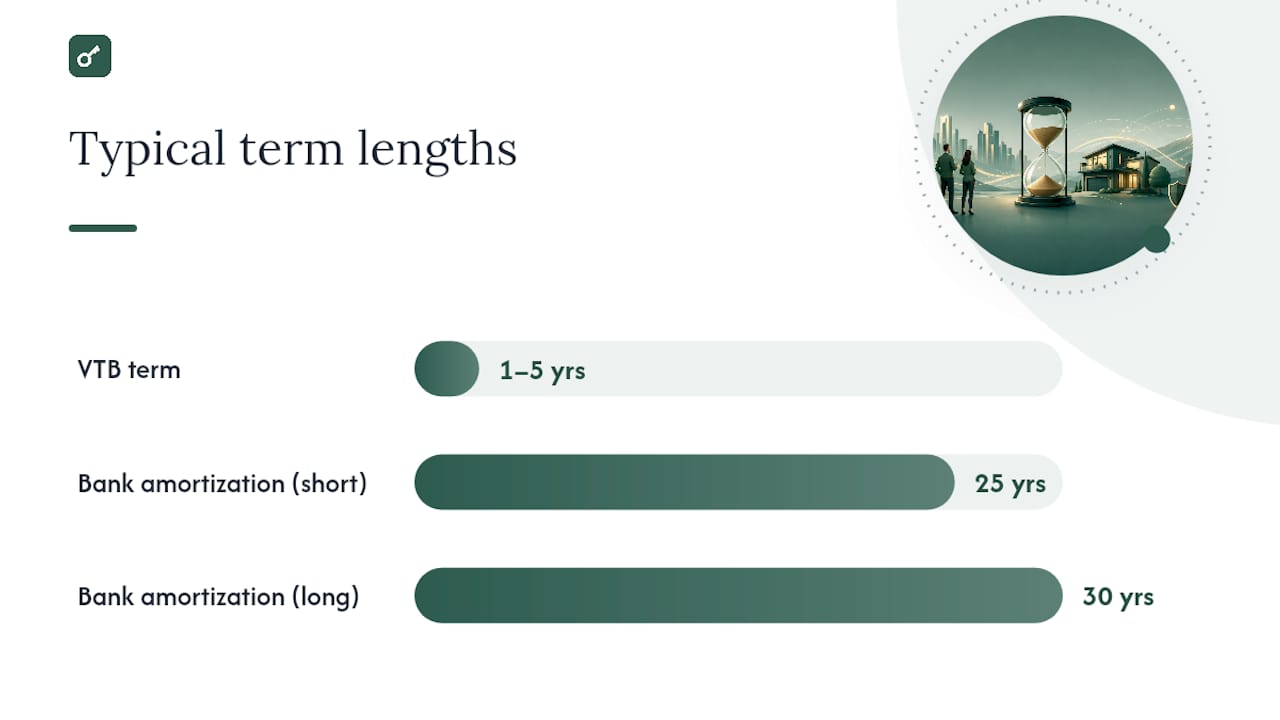
Term length is the other big departure from conventional financing. Where a bank mortgage might amortize over 25 or 30 years, a VTB commonly runs one to five years, often with interest-only payments and a lump balloon payment due at maturity. The buyer's plan, in most cases, is to refinance into a conventional mortgage once their income documentation, credit, or down payment improves enough to qualify.
Statutory ceiling to know: Under section 347 of the Criminal Code, no lender in Canada, including a seller carrying a VTB, can charge an effective annual interest rate above 35%. Private VTB rates sit well under that ceiling in practice, but it's the hard legal boundary.
A second, less obvious trap sits in the Interest Act rather than the Criminal Code.
- Section 4 of the Interest Act can make an interest clause unenforceable if it states a rate for a period shorter than a year, like monthly, without also stating the equivalent annual rate.
- This routinely trips up hand-drafted VTB notes where a seller and buyer write "1% per month" and nothing else.
- The fix is simple on paper (state the annual equivalent), but it's exactly the kind of clause a lawyer catches and a DIY agreement misses.
Who uses a VTB, and what can go wrong for each side
VTBs cluster where conventional lending is tight or unusual: commercial and farm sales, properties with unconventional income streams, and soft markets where buyers are scarce. Investors use them to acquire property with less upfront cash. Sellers use them to defer a lump-sum capital gain, generate ongoing interest income, or simply close a sale that wouldn't happen otherwise.
The risk sits on both sides of the closing table, and it isn't symmetrical.
- Priority risk for sellers in second position. If the buyer defaults, the first mortgage holder gets paid before the seller sees anything, and in a falling market that can mean a partial or total loss on the VTB balance.
- Enforcement cost and effort for sellers. Collecting on a defaulted mortgage means legal proceedings, and provincial rules on how fast that can happen vary significantly.
- Monitoring burden for sellers. A lapsed insurance policy or unpaid property tax bill on a property the seller no longer owns but is still owed money against is a real and recurring risk.
- Balloon risk for buyers. If refinancing plans fall through at maturity, whether due to a rate spike, an appraisal shortfall, or a credit event, the buyer can be forced to sell or face default on the balloon payment.
- Disclosure obligations for buyers. Any VTB registered behind an existing institutional mortgage has to be disclosed to that first lender, and most lenders require written consent before allowing it.
Buyers with strong income but thin credit history, and sellers who own a property outright and want investment-style returns instead of a lump sum, are the two profiles that show up most often on either side of a VTB.
How the CRA taxes a seller's VTB payments
This is the section that surprises the most sellers, because a VTB payment isn't one thing tax-wise. It's two things layered together, and each is taxed completely differently.
- Principal repayments count toward the capital gain on the sale. Because the seller isn't receiving the full sale price up front, the capital gains reserve lets them spread recognition of that gain over as many as five years instead of reporting it all in the year of sale.
- Interest received is not part of the capital gain calculation at all. It's ordinary investment income, fully taxable in the year received, and reported on Line 12100 of the seller's tax return.
- The two don't offset each other. A seller can defer gain recognition on the principal while still owing full tax on every dollar of interest collected that same year.
Pro Tip: Run the numbers before you agree to a rate. A seller comparing "defer my capital gain" against "collect 6% interest annually" needs to know the interest income shows up on next year's tax bill in full, even while the capital gain is still being spread out. Modelling both cash flows side by side with a capital gains calculator turns a rough guess into an actual after-tax comparison.
The reserve mechanism is genuinely useful for sellers who want to smooth out a large gain, but it's not a tax-free ride. It's a deferral, not an exemption, and the interest portion never gets the deferral treatment at all. An accountant who models both income streams together, rather than looking at the capital gain in isolation, is the difference between a VTB that pays off as planned and one that leaves a seller with an unexpected tax bill in April.
Lender consent, insurer rules, and provincial enforcement differences
Three constraints sit outside the buyer's and seller's control entirely, and missing any one of them can unravel a deal that otherwise looks fine on paper.
- Insured mortgages are off the table. High-ratio mortgages backed by CMHC, Sagen, or Canada Guaranty require the down payment to come from the buyer's own resources, not seller financing, so a VTB used to cover part of the down payment disqualifies the file for insured financing entirely.
- Consent from the first lender is usually mandatory. When a VTB sits in second position behind an institutional first mortgage, most federally regulated lenders require written consent before allowing the secondary charge, and combined loan-to-value commonly needs to stay under roughly 80%.
- Enforcement rules differ by province. Ontario and other power-of-sale provinces let a mortgage holder move relatively quickly to enforce a default; judicial-sale provinces require a court process that takes longer and costs more. A seller accepting a five-year VTB in a judicial-sale province is taking on a materially different risk than the same deal in a power-of-sale one.
Negotiating lender consent early, before the purchase agreement becomes firm, avoids the scenario where a deal collapses at the eleventh hour because the buyer's bank won't sign off on the secondary charge. It's a five-minute phone call that saves weeks of wasted conditional-offer time.
Two Canadian VTB scenarios with real numbers
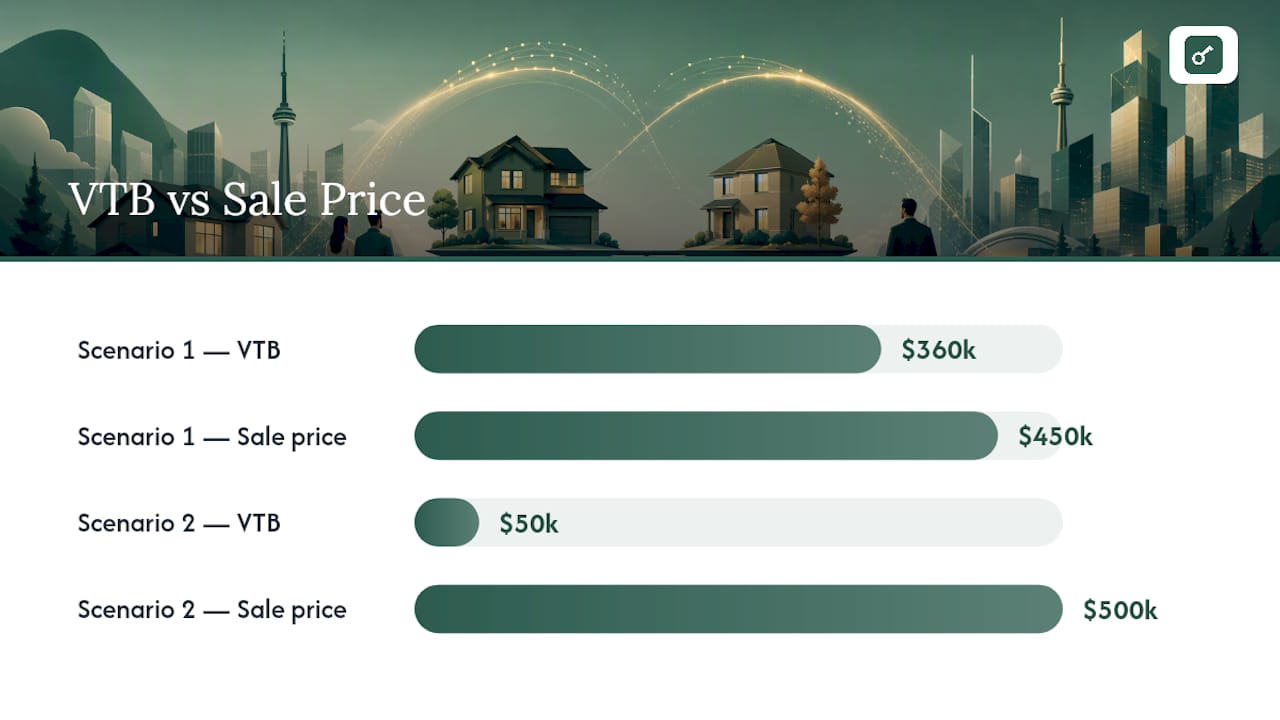
Scenario one: VTB as sole financing. A retiring couple sells a $450,000 rural property to a young buyer who has a stable income but only two years of self-employment history, not enough for a bank to approve a full mortgage yet. The seller carries a first-position VTB for $360,000 (80% of the price) at a 7% interest-only rate over a three-year term. Monthly payments run about $2,100, covering interest only, with the full $360,000 balloon due at the end of year three, by which point the buyer expects three full years of tax returns to qualify for a bank refinance.
Scenario two: VTB as second mortgage. A buyer secures an institutional first mortgage for $400,000 on a $500,000 home (80% LTV) and asks the seller to carry a $50,000 second-position VTB to cover the rest of the down payment shortfall, at 9% interest-only over two years. The bank's consent is required because the combined loan-to-value hits 90%, above the roughly 80% ceiling many lenders prefer for secondary financing, so approval isn't guaranteed and needs to be confirmed before the deal firms up.
- In both cases, the seller's real exposure is the balloon amount, not the monthly payment, since a $50,000 or $360,000 lump sum due on a fixed date is what fails if the buyer can't refinance on time.
- Running the monthly figures through a mortgage payment calculator before signing shows both sides exactly what the interest-only period costs and what the balloon will look like at maturity.
When a private second mortgage or RRSP withdrawal beats a VTB
A VTB isn't the only route to close a financing gap, and it usually isn't the seller's or buyer's first choice if a cleaner option is available.
- Private second mortgages and bridge loans from a licensed lender do the same job as a VTB, closing a short-term gap, without tying the seller's money up in the deal or exposing them to registration and enforcement risk.
- A larger down payment, a co-signer, or better income documentation can sometimes push a buyer over the line for full institutional financing, avoiding secondary charges entirely.
- The RRSP Home Buyers' Plan lets a first-time buyer pull registered savings toward a down payment, which can close a gap that would otherwise need seller financing.
- A comparison of cash offers versus traditional financed sales shows the same trade-off shows up in other markets: speed and certainty on one side, flexibility and higher potential return on the other.
A VTB tends to make sense specifically when none of these alternatives close the gap on their own, whether because the buyer's file doesn't fit a bank's box or the seller specifically wants the tax deferral or income stream a straight sale wouldn't provide.
Model the numbers before you sign anything
Most VTB negotiations go wrong because someone agrees to a rate or a term length before running the actual cash flows. Model the principal and interest portions separately, since they're taxed differently for the seller and cost differently for the buyer, and stress-test the balloon repayment against a refinance that takes longer than expected. Once the numbers make sense on paper, get independent legal and tax advice before you sign, because a VTB drafted casually is where most of the real risk lives.
— Costtoclose
Test your VTB numbers before you negotiate terms
If you're weighing seller financing against a straight cash sale, Modelling tools are available to see exactly where the money goes, without pushing you toward any particular lender or structure.
Start with the mortgage payment calculator to test interest-only schedules and balloon payment scenarios against different rates and term lengths. Sellers weighing a capital gains reserve against upfront interest income can run both outcomes through the capital gains calculator to see the after-tax difference in real dollars, and the closing cost calculator shows what net proceeds look like on a cash sale for comparison. None of these tools replace a lawyer or an accountant, but they turn a vague negotiating position into numbers you can actually defend at the closing table, and they cost nothing to try before you finalize a single term.
Sources
FAQ
What are the risks of a vendor take back mortgage?
Sellers risk losing part or all of the balance if the buyer defaults, especially in second position behind a bank mortgage, plus enforcement costs and the burden of monitoring insurance and taxes. Buyers risk higher interest costs and a balloon payment they may not be able to refinance on schedule.
What is an example of a vendor take back mortgage?
A common example is a seller carrying $50,000 of a home's price as a second-position VTB at 9% interest-only over two years, behind an $400,000 institutional first mortgage, with the buyer refinancing the VTB once their credit file improves.
Who typically uses VTB mortgages?
Investors buying with less upfront cash, sellers seeking to defer or spread capital gains tax, and buyers with short-term financing gaps, such as thin credit history or unconventional income, make up the bulk of VTB users, particularly in commercial, farm, or soft residential markets.
Is a VTB a good idea?
A VTB can work well when it closes a genuine financing gap and both sides document it like an institutional loan, but it carries real priority and enforcement risk for sellers and balloon risk for buyers. Modelling the cash flows with tools like a mortgage payment calculator before signing, and getting independent legal and tax advice, is what separates a VTB that works from one that doesn't.
Recommended
- RRSP Home Buyers' Plan Calculator (2026)
- Canadian Closing Cost & Land Transfer Tax Calculator (2026)
- Mortgage Renewal Calculator Canada (2026)
- Mortgage Refinance Calculator Canada (2026)
This article is only for educational purposes and not a financial advice. Do your own due diligence and do not base your financial decisions on any this article.