
Quebec's welcome tax, officially the property transfer duty, is charged on whichever is highest of the purchase price, the deed's stated consideration, or the municipal assessment multiplied by a comparative factor. It's calculated in brackets, not a flat rate, so most buyers owe a percentage of that value typically starting from 0.5%, with higher rates applicable in Montréal. First time buyers can now recover a meaningful chunk of it through a new 2026 refundable credit, but only if a notary confirms eligibility before the invoice arrives.
TL;DR:
- The property transfer duty in Quebec is calculated based on the highest of the purchase price, deed consideration, or municipal assessment times the applicable comparative factor, which can push costs higher than the sale price.
- Municipalities, especially Montreal, often adopt higher brackets and rates than the provincial standard, making the final duty significantly variable depending on the location and assessed values.
- First-time buyers can claim a refundable credit in 2026 that covers part of the transfer duty, but eligibility must be confirmed beforehand, including household ownership history.
- The municipality typically sends the invoice three to six months after registration, and payment is due within 30 days, so buyers should set aside funds early to avoid surprises.
- Disputes over the welcome tax usually involve questioning the assessed value used for calculation rather than the rate itself, with limited success unless a clear error or exemption applies.
Table of Contents
- What is the welcome tax in Quebec, legally speaking?
- How to calculate welcome tax in Quebec: the bracket method
- Montréal and other municipal differences
- Exemptions and the 2026 first-time buyer credit
- When and how to pay the welcome tax
- Worked example: calculating the tax on a $400,000 purchase
- Can you dispute a welcome tax assessment?
- How Quebec's welcome tax compares to other provinces
- Does the property type change your welcome tax bill?
- Practitioner perspective: what notaries and municipal officers want you to know
- Plan your Quebec closing costs before the invoice lands
- Where to verify the numbers yourself
- Sources
- FAQ
What is the welcome tax in Quebec, legally speaking?
The welcome tax isn't a nickname for something vague. It's a duty created under the Act respecting duties on transfers of immovables, which requires every Quebec municipality to collect it whenever a property changes hands. The buyer, called the transferee in the legislation, is the one who owes it. Not the seller, not the notary, not the real estate agent.
The name "welcome tax" comes from Jean Bienvenue, the provincial minister who introduced the legislation in 1976. It stuck because it captures exactly what it feels like: a bill for the privilege of moving in.
Three numbers can determine your tax base:
- The price you actually paid for the property
- The consideration stated in the notarized deed of sale
- The municipal assessment multiplied by that municipality's comparative factor
Whichever of those three is largest becomes your base, according to OACIQ's guidance for buyers. Brackets themselves are indexed to Quebec's Consumer Price Index each year, so a bracket threshold that applied last year may shift slightly for a 2026 transaction.
How to calculate welcome tax in Quebec: the bracket method
Calculating the duty is a two-step process, and skipping the first step is where most people go wrong.
- Determine your tax base. Pull your municipal assessment (available on your property tax bill or the municipal roll) and multiply it by the comparative factor for that year. Compare that figure against your purchase price and the deed's stated consideration. Take the highest number.
- Apply the bracket rates to each portion of that base. Each bracket applies only to the value portion that falls within it, similar to progressive income tax systems.
The standard 2026 provincial brackets, before any municipal bylaw pushes them higher, work roughly like this:
Standard Quebec brackets: 0.5% on the portion up to the first threshold, 1% on the next portion, and 1.5% on amounts above that. Municipalities can adopt bylaws creating additional brackets above higher property values, and several large cities have done exactly that.
Here's the arithmetic on a $350,000 tax base, using standard brackets before any municipal override:
- 0.5% on the first $61,500 = $307.50
- 1% on the next $246,300 (from $61,500 to $307,800) = $2,463
- 1.5% on the remaining $42,200 (above $307,800) = $633
Total: roughly $3,403.50. That's before any municipal bylaw variation, and it assumes your tax base is your purchase price rather than a higher assessed value.
Montréal and other municipal differences
Montréal doesn't use the standard brackets. It runs its own multi-band schedule with rates that can exceed the province's baseline 1.5% ceiling, and the city's own explanation lays out the full structure.
Montréal's 2026 brackets look like this:
- Up to $62,900: 0.5%
- $62,900 to $315,000: 1%
- $315,000 to $552,300: 1.5%
- $552,300 to $1,104,700: 2%
- Above $1,104,700: rates climb further, up to 4% on the highest bands
Québec City and most other municipalities across the province still follow the standard three bracket structure, so a $700,000 purchase can trigger a materially different bill depending on which side of the Island of Montréal it falls on.
The comparative factor adds another wrinkle. Montréal updates the comparative factor yearly to adjust assessed values toward actual market sale prices citywide, and in a rising market that factor can push your assessed value above your negotiated purchase price, meaning you pay duty on a number you never actually agreed to.
Pro Tip: Before you finalize your offer, call your municipality (311 in Montréal) or check its website for the current comparative factor and any bylaw setting rates above the provincial standard. Don't assume every city taxes the same way Montréal does.
Exemptions and the 2026 first-time buyer credit
Not every transfer triggers the full duty. Ville de Montréal's guidance for new homeowners lists several exemption categories, though none apply automatically. You have to claim them and back them up with documentation.
Common exemptions include:
- Transfers between close family members (spouses, direct-line relatives) under specific conditions
- Transfers to certain legal entities, such as a transfer from an individual to a corporation they control, provided ownership and structure rules are met
- Some transfers tied to farm land or specific public-sector transactions
The bigger news for 2026 is the refundable tax credit for first-time buyers announced by the Quebec government. Eligible buyers get a refund covering the first portion of transfer duty paid, plus a percentage of remaining duties up to a capped amount, for a maximum benefit in the low thousands of dollars. The credit phases down for homes priced above a certain threshold and phases out entirely above a higher limit. Eligibility requires that no household member have owned property in the last several years, a condition that buyers should verify carefully, including partners' ownership history. Confirm this with a notary before you count on the credit in your budget.
When and how to pay the welcome tax
Nobody hands you this bill at closing, which is exactly why it catches so many buyers off guard.
- The municipality typically mails an invoice three to six months after your deed is registered at the Land Registry Office.
- Payment is generally due within 30 days of that invoice date. Under the Act respecting duties on transfers of immovables, the duty becomes exigible starting the 31st day after the account is sent, and interest starts accruing from that point if you haven't paid.
- Your notary almost never collects this money at closing. It's a separate, later transaction between you and the municipality.
Pro Tip: Set aside your estimated welcome tax the day you close, in a separate account you won't touch. Municipal guidance confirms invoices routinely arrive months later, and by then it's easy to have spent the money on furniture or moving costs.
If four to six months pass after your closing date and nothing has shown up in the mail or your municipal online account, contact the municipality directly. A missing invoice doesn't mean a missing obligation.
Worked example: calculating the tax on a $400,000 purchase
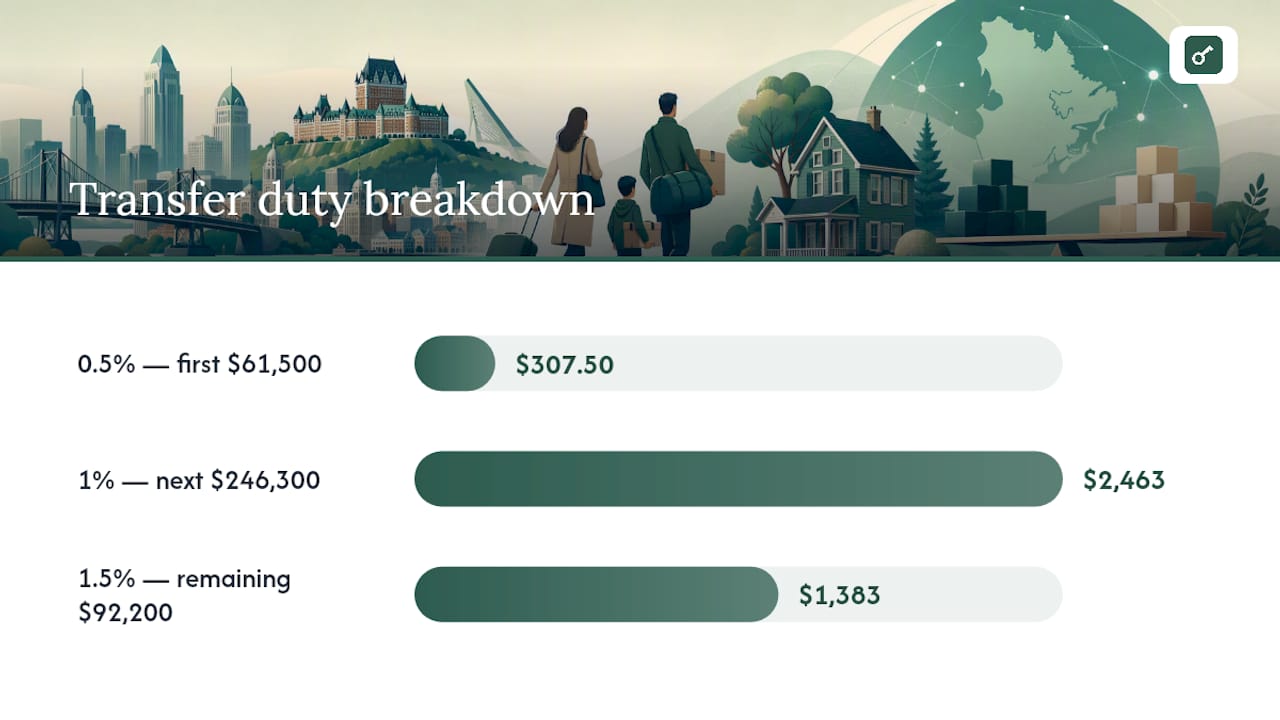
Say you're buying a home for $400,000 outside Montréal, at the standard provincial brackets, and your municipal assessment times comparative factor comes in lower than your purchase price. Your tax base is $400,000.
- 0.5% on the first $61,500 = $307.50
- 1% on the next $246,300 = $2,463
- 1.5% on the remaining $92,200 = $1,383
Total transfer duty: approximately $4,153.50.
To find your own real inputs, gather three things: your confirmed purchase price from the offer to purchase, the consideration stated in your notarized deed, and your municipal assessment along with that city's current comparative factor (available on the municipal website or through 311 in Montréal).
Costtoclose's Canadian closing cost and land transfer tax calculator runs these bracket calculations automatically for Quebec purchases, factoring in regional rate differences so you're not doing the arithmetic by hand. It's built for planning purposes. Treat any calculator output as an estimate to budget around, not the final number, since only your municipality's invoice or your notary's calculation is legally binding.
Can you dispute a welcome tax assessment?
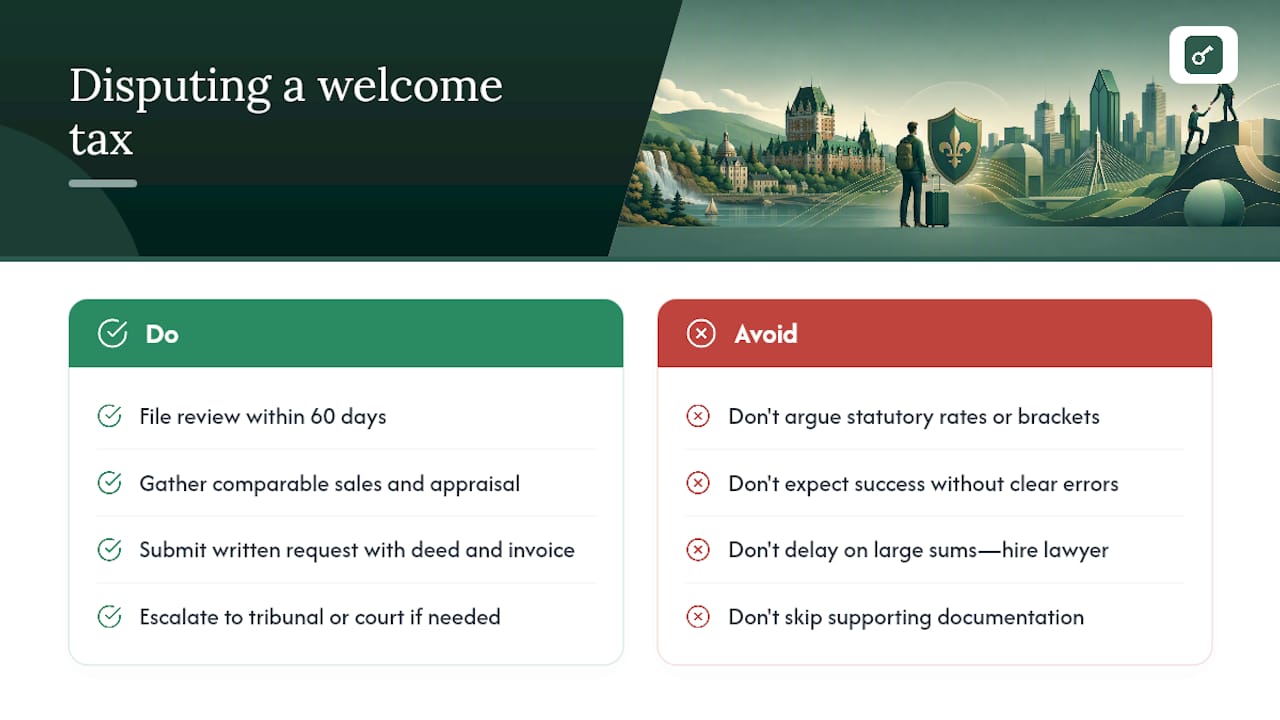
Yes, though disputes over the welcome tax usually center on the assessed value used to calculate your tax base, not the rate itself. The brackets and rates are set by statute or municipal bylaw, so there's rarely room to argue about the math once the base is established. The base itself is a different story.
If you believe your municipal assessment doesn't reflect your property's actual value, or the comparative factor applied seems out of step with market conditions, you generally have a window (often 60 days from receiving your assessment notice, though this varies by municipality) to file a formal request for review with the municipal assessment division. This is a separate process from a standard property tax appeal, but it draws on the same evidence: comparable sales, a private appraisal, or documentation showing the assessment roll contains an error specific to your unit or lot.
For disputes about how the duty itself was calculated (wrong bracket applied, an exemption denied without explanation, interest charged incorrectly), you typically start by contacting the municipal revenue or taxation department directly, in writing, with your deed and invoice attached. If that doesn't resolve things, some municipalities allow escalation to an administrative tribunal or, in limited cases, the courts.
The practical reality is that successful disputes are uncommon and usually narrow. Most challenges succeed only when there's a clear documentation error, such as the wrong property being assessed, a duplicate charge, or an exemption application that was rejected on a technicality rather than the merits. If you're disputing a five or six figure sum, get a notary or real estate lawyer involved early. The paperwork trail matters more than the argument.
How Quebec's welcome tax compares to other provinces
Every Canadian province except Alberta and Saskatchewan charges some form of land transfer tax, but Quebec's structure has quirks that surprise buyers moving in from elsewhere.
British Columbia's property transfer tax runs up to 3% on higher-value tiers, with an additional 2% foreign buyer surtax in specific regions. Quebec's top standard bracket sits at 1.5% outside major cities, which looks modest by comparison, until you land in Montréal, where the added bands push effective rates on luxury properties well past what Toronto or Vancouver charge on an equivalent value.
The comparative factor is the real outlier. Ontario and BC calculate their transfer taxes almost entirely off the negotiated sale price. Quebec, and Montréal specifically, can tax you on an assessed value higher than what you paid, a mechanism most other provinces simply don't use. That's a meaningful structural difference, not just a rate difference.
Quebec is also the only province with a dedicated first-time buyer transfer tax rebate as sweeping as the 2026 credit. Ontario offers a land transfer tax rebate for first-time buyers too, capped at $4,000, but Quebec's new credit reaches up to $5,875 and applies province-wide rather than only in specific municipalities.
Does the property type change your welcome tax bill?
The welcome tax applies to most transfers of immovable property in Quebec, but what you're buying, and how you're buying it, changes the calculation in ways that trip up even experienced buyers.
A single-family home follows the standard calculation described earlier: highest of price, deed consideration, or assessed value times comparative factor. A condominium follows the same logic, but the municipal assessment for a condo unit is sometimes lower relative to market price than for a detached house, which can mean your purchase price, not the assessed value, ends up as your tax base more often.
Duplexes, triplexes, and small multi-unit buildings get taxed on the full transaction value, including all units, even if you plan to live in one and rent the others. There's no partial exemption for the owner-occupied portion.
New construction carries a separate wrinkle: GST and QST apply to the purchase price of a new build, but those sales taxes are calculated independently of the welcome tax and don't get folded into your transfer duty base. You'll face both bills, just calculated on different rules.
Transfers that aren't a straightforward cash sale, like a transfer between related parties, a transfer into a trust, or a transfer as part of an estate settlement, can qualify for exemptions covered earlier, but each requires its own documentation to the municipality. A private sale between family members without proper paperwork gets taxed exactly like an arm's length transaction, comparative factor and all.
Practitioner perspective: what notaries and municipal officers want you to know
Notaries see the same mistake constantly: buyers budget the welcome tax off the sale price alone, then get blindsided when the comparative factor pushes the real base higher. Others assume the 2026 credit applies to them without checking the household four-year ownership test, only to find a spouse's old condo disqualifies them.
The fix is simple and unglamorous: ask your notary, before closing, what tax base they expect the municipality to use, and confirm credit eligibility in writing. A calculator sharpens your budget. It doesn't replace the municipal invoice or your notary's read on your specific file.
— Rachit
Plan your Quebec closing costs before the invoice lands
You've seen how much the numbers can shift between a standard bracket calculation and Montréal's higher bands, and how a comparative factor can quietly raise your tax base above your purchase price. That's exactly the kind of surprise a calculator built for Canadian real estate transactions is meant to catch before it catches you.
Costtoclose's closing cost and land transfer tax calculator uses regional rate data to estimate your welcome tax alongside the rest of your closing costs, legal fees, adjustments, and prepaid items included, so you see one total figure instead of guessing at pieces. Enter your purchase price and municipality, and it returns an estimated transfer duty, total closing costs, and the cash you'll need on hand at closing. If you're also weighing how a Home Buyers' Plan withdrawal fits your down payment, pair it with the RRSP Home Buyers' Plan calculator to see the full cash picture before you make an offer.
Remember that any calculator produces a planning estimate. Your municipality's invoice and your notary's calculation are what actually determine the legally binding amount. Run your numbers now, then confirm them once your notarized deed and municipal assessment are in hand.
Where to verify the numbers yourself
Confirm current rates and bylaws directly with your municipality, and check the Act respecting duties on transfers of immovables and OACIQ's transfer duty guidance for the legal framework. For binding advice on your specific file, ask your notary.
Sources
- How property transfer duties are calculated | Ville de Montréal
- Act respecting duties on transfers of immovables (English translation) | Légis Québec
- Quebec to reimburse 'welcome tax' for first-time homebuyers | CBC News
- Property transfer duties | OACIQ
FAQ
Is there a refund for the welcome tax in Quebec?
Yes, starting in 2026 eligible first-time buyers can claim a refundable credit covering the first $5,000 of duty plus up to 25% of the remainder, to a maximum of $5,875, subject to a household four-year ownership test and phaseouts above $750,000.
How do I calculate the welcome tax in Quebec?
Take the highest of your purchase price, deed consideration, or municipal assessment times the comparative factor, then apply the bracket rates to each portion of that value, using Montréal's brackets if you're buying there or the standard provincial brackets elsewhere.
How do I pay the welcome tax in Montréal?
The city mails an invoice, typically three to six months after registration, and payment is due within 30 days; check your account through Montréal's municipal portal or call 311 if no bill has arrived within that window.
What are the two taxes in Quebec relevant to buying a home?
Buyers typically encounter the welcome tax (property transfer duty), owed once after purchase, and ongoing annual municipal property tax; new construction buyers may also face GST and QST, calculated separately from the transfer duty.
Can Costtoclose calculate my exact welcome tax amount?
Costtoclose's closing cost calculator gives a reliable planning estimate based on your purchase price and municipality, but your municipality's official invoice remains the final, legally binding figure.